

SEO vs Google Ads is one of the first big decisions every business owner faces when they decide to grow online — and most people frame it as a fight, where one channel has to win. It doesn’t. The honest answer is that SEO and Google Ads solve different problems on different timelines, and the businesses that grow fastest usually run both. This guide breaks down exactly how SEO vs Google Ads compare on cost, speed, trust, and return, when to choose each, and how to combine them so the two channels make each other stronger.
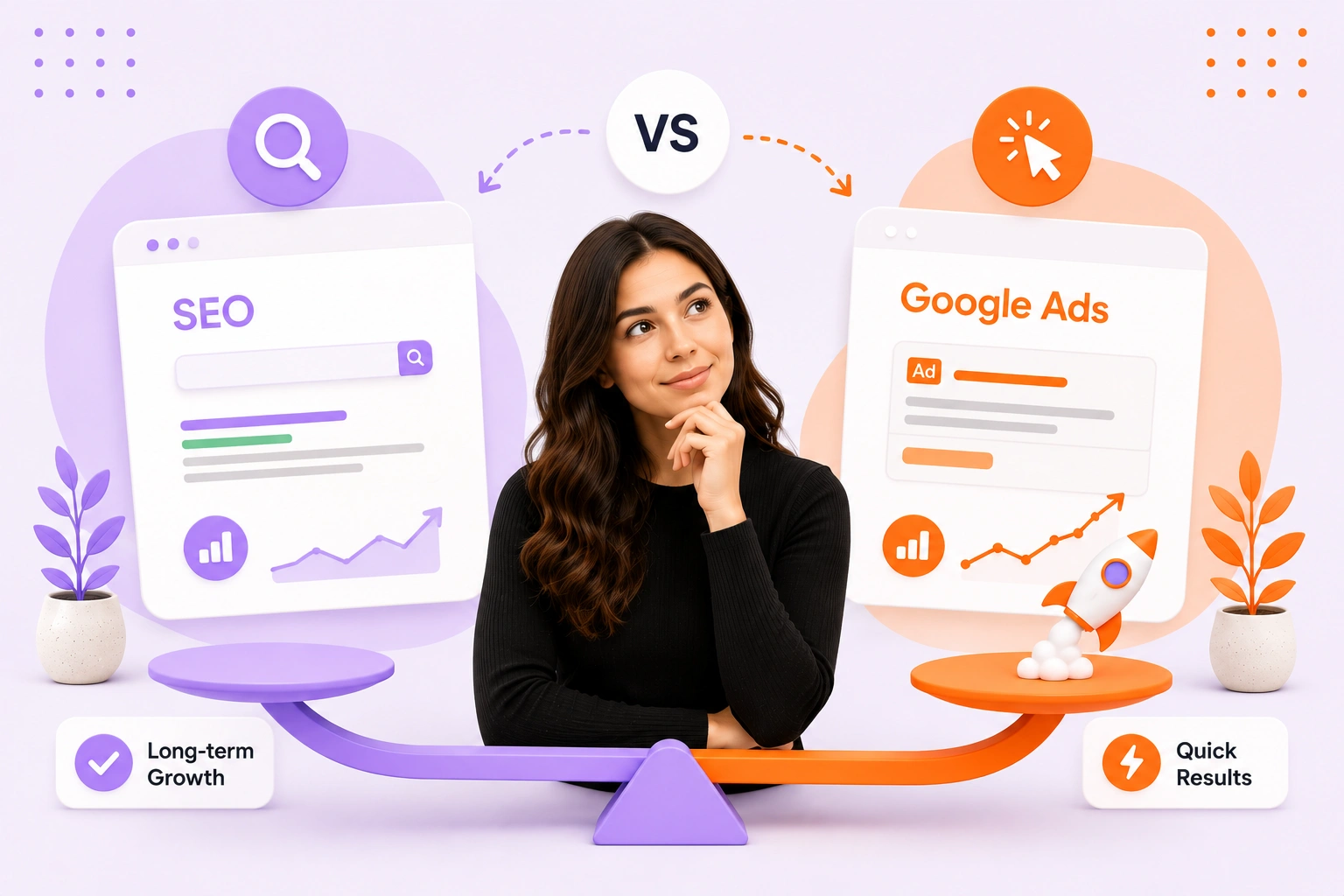
Table of Contents
SEO vs Google Ads: The 30-second Answer
If you need leads this week, start with Google Ads — you can be at the top of the results within hours. If you want traffic that compounds and keeps paying off after you stop spending, invest in SEO. Most growing businesses shouldn’t pick one; they should use Google Ads to buy demand now while SEO builds an asset that lowers their cost per lead over time.
Here’s the quick version before we go deep:
| SEO | Google Ads | |
| Speed to results | 3–6+ months | Same day |
| Cost model | Time + content + links | Pay per click |
| What happens when you stop | Traffic continues (decays slowly) | Traffic stops instantly |
| Trust / click share | Higher long-term trust | Top-of-page visibility, “Sponsored” label |
| Best for | Long-term, evergreen demand | Immediate leads, promotions, testing |
What SEO Actually Is
SEO (search engine optimization) is the practice of earning unpaid rankings in Google’s organic results. You optimize your pages, publish helpful content, earn links and reviews, and over time Google rewards you with visibility for the terms your customers search.
The upside: once you rank, every click is “free.” A page that ranks for “emergency plumber near me” can generate leads for years without a per-click cost. Organic results also carry more long-term trust — many people scroll past the ads to the first organic listing.
The trade-off: SEO is slow. A new or low-authority site often needs three to six months (sometimes longer in competitive niches) before rankings and traffic become meaningful. It’s an investment that pays back later, not a faucet you turn on today. You can see how Google frames the fundamentals in Google’s own SEO documentation.
What Google Ads Actually Is
Google Ads is pay-per-click (PPC) advertising. You bid on keywords, write ads, and pay only when someone clicks. Your ad can appear at the very top of the results — above every organic listing — almost immediately after launch.
The upside: speed and control. You can turn leads on today, target exact keywords and locations, set your budget, and measure cost per lead precisely. It’s the fastest way to test which offers and keywords actually convert.
The trade-off: the moment you pause the budget, the traffic disappears. Costs can also climb in competitive industries, where a single click in legal or home services can run $50–$150+. Your results depend heavily on Quality Score — Google’s measure of how relevant your ads and landing pages are — so cheap, sloppy campaigns quietly burn money.
SEO vs Google Ads: The Head-to-head Comparison
This is the table to bookmark. It’s the clearest way to see how SEO vs Google Ads stack up across the factors that actually affect your bottom line.
| Factor | SEO | Google Ads |
| Time to first results | 3–6+ months | Hours |
| Cost structure | Content, technical work, links (mostly fixed/ongoing) | Per click (variable) |
| Cost over time | Drops as rankings compound | Stays or rises with competition |
| Longevity | Traffic persists after you stop | Stops the day you pause |
| Position on page | Below the ad block | Top of page, “Sponsored” |
| Click-through trust | Higher for informational intent | Strong for commercial intent |
| Targeting control | Indirect (keywords, intent) | Precise (keyword, location, device, time) |
| Best-fit goals | Brand authority, evergreen demand | Immediate leads, launches, seasonal spikes |
| Measurability | Improving, but attribution is fuzzier | Click-and-conversion precise |
Notice that almost nowhere does one channel beat the other on every row. They’re complements, not substitutes — which is the whole point.
The Real Cost of SEO vs Google Ads
Cost is where the SEO vs Google Ads debate gets oversimplified. People say “SEO is free” and “ads are expensive.” Both are misleading.
Google Ads cost is transparent and immediate: you pay per click, and your cost per lead is your spend divided by conversions. In a competitive home-services market, you might pay $20–$80 per click and land a lead for $80–$200 — but you get those leads on day one.
SEO cost is front-loaded and indirect: you pay for content, technical fixes, and links (or the hours to do them). For months you may spend without much return. But as pages start ranking, your effective cost per lead falls — and keeps falling — because you’re no longer paying for each click.
The smart way to think about it: Google Ads has a low upfront cost and a flat long-term cost. SEO has a high upfront cost and a low long-term cost. That single trade-off is the heart of the SEO vs Google Ads cost question. Over a 12–24 month horizon, SEO usually wins on cost per lead. In the first 90 days, Google Ads wins on leads, full stop.
Speed: Why Google Ads Wins the Short Game
On raw speed, the SEO vs Google Ads gap is enormous — and there’s no contest here. Launch a well-built campaign and you can have qualified clicks within hours. That makes Google Ads the right tool when you:
- Just launched and have zero organic visibility.
- Need cash flow and bookings now.
- Want to test which offers, keywords, and landing pages convert before investing in content.
- Have a time-sensitive promotion or a seasonal rush (think roofing after a storm, HVAC in a heatwave).
SEO simply can’t move that fast. Which is exactly why pausing all paid spend to “save money and do SEO instead” is one of the most expensive mistakes small businesses make.
Trust and Clicks: Why SEO Wins the Long Game
On trust, the SEO vs Google Ads picture flips. Many searchers — especially on research-style queries — skip past the ad block and click the first organic result. Ranking organically signals that Google chose you, not that you paid to be there, and that earns trust.
But this cuts both ways. On high-commercial, ready-to-buy searches, the ads own the top of the page, and being there is worth a lot. So the trust advantage of SEO is real for top-of-funnel and informational searches, while Google Ads dominates the bottom-of-funnel moment when someone is ready to call.
SEO vs Google Ads: Which Is Right for You?
Use this framework to decide where to put your next dollar.
| Your situation | Start with |
| Brand-new website, no rankings, need leads | Google Ads |
| Tight budget, playing the long game | SEO |
| Established site, want to scale faster | Both |
| Highly seasonal demand (HVAC, roofing) | Google Ads for peaks, SEO for evergreen |
| Very competitive paid niche (high CPCs) | SEO to lower blended cost, Ads to stay visible |
| Local service business | Both — see the next section |
| Testing a new offer or market | Google Ads first, then SEO around what converts |
Why the Smartest Play Is SEO and Google Ads Together
Here’s the part the “SEO vs Google Ads” framing hides: the two channels are far more powerful together than apart. Treating them as rivals leaves money on the table.
Ads fund the wait. Google Ads brings in leads immediately, so your business keeps growing during the months SEO needs to mature. You’re never sitting idle waiting to rank.
Ads hand SEO a cheat sheet. Your paid campaigns show you, with real conversion data, exactly which keywords and offers turn into customers. You build your SEO content around proven winners instead of guessing.
You own more of the page. When you appear in both the ads and the organic results for the same search, you take up more space, push competitors down, and increase the odds of the click. Studies consistently show ads and organic together capture more total traffic than either alone.
Remarketing compounds your SEO traffic. Visitors who find you through an organic article can be re-engaged with Google Ads later, turning free content readers into paid-channel conversions.
You defend your brand. Running ads on your own brand terms stops competitors from buying clicks that should be yours — while your organic listing handles everyone else.
This is why we treat SEO as additive to Google Ads, never as a replacement. The right question is rarely “SEO or Google Ads?” It’s “what’s the right mix for where my business is right now?”
SEO vs Google Ads for Local and Home Service Businesses
For local and home-service companies — plumbers, HVAC, roofers, electricians, cleaners — the SEO vs Google Ads calculation has its own rules, and it’s less about choosing a side than about timing each one right.
Google Ads gets you in front of “near me” and emergency searches instantly, including Local Services Ads (the “Google Guaranteed” listings) that put you at the very top with a call button. That’s perfect for urgent, high-intent jobs.
SEO for local businesses is anchored by your Google Business Profile and the map pack — the block of three local results under the map. Optimizing your profile, gathering reviews, and building location pages earns you steady, no-cost visibility for the searches that repeat every day.
The seasonal angle matters too. A roofer should lean hard on Google Ads during storm season and an HVAC company during the first heatwave, while both build SEO year-round so that when demand spikes, they own the organic results and the ads. Pay to win the rush; rank to win the year.
Common SEO vs Google Ads Mistakes
A handful of SEO vs Google Ads mistakes show up again and again:
- Cutting all paid spend to “switch to SEO,” then going months with no leads.
- Expecting SEO to deliver in weeks — and quitting right before it works.
- Running Google Ads to a generic homepage instead of a focused landing page, tanking Quality Score.
- Ignoring the keyword and conversion data your ads generate — that’s free SEO research.
- Measuring the two channels in isolation instead of as one funnel.
Final Verdict
SEO vs Google Ads isn’t a battle with a single winner. Google Ads is the fastest way to buy demand today; SEO is the best way to build an asset that lowers your cost per lead for years. For most businesses, the move is to start with Google Ads for immediate, measurable leads, layer in SEO so traffic compounds, and let each channel feed the other. Choose based on your timeline, budget, and how urgently you need customers — not on a false either/or.
You don’t have to choose — we do both. WOW Portals runs your Google Ads management and your SEO as one coordinated strategy, so your paid leads start today while your organic pipeline compounds. One team, both channels, pulling in the same direction.
Frequently Asked Questions
Is SEO cheaper than Google Ads?
Over the long run, usually yes — once your pages rank, you stop paying per click, so your cost per lead keeps dropping. In the short run, Google Ads is cheaper to get started, because SEO front-loads the investment before any return.
Is SEO better than Google Ads?
Neither is universally better. SEO wins on long-term cost and trust; Google Ads wins on speed and control. The best results come from using them together rather than choosing one.
How long until SEO beats Google Ads on cost?
For most small businesses, organic traffic starts to overtake paid on a cost-per-lead basis somewhere between 6 and 18 months, depending on competition and how aggressively you invest in content and links.
Should a small business do SEO or Google Ads first?
If you need leads quickly, start with Google Ads, then reinvest some of those profits into SEO. If you have time and a tight budget, you can start with SEO — just expect a slower ramp before the leads arrive.