
OpenAI opened ChatGPT to advertisers in 2026, and the self-serve Ads Manager now has no minimum spend. Here’s exactly how to run ads on ChatGPT, what they cost, and whether they’re right for your business.
Until recently, you couldn’t buy advertising inside ChatGPT at any price. That changed in 2026. OpenAI began testing ads in February, and by May it had rolled out a self-serve Ads Manager that removed the original six-figure spend minimum entirely. For the first time, small and mid-sized businesses can reach hundreds of millions of ChatGPT users at the exact moment they’re making decisions.
This guide walks through how to run ads on ChatGPT step by step: what the ads look like, how OpenAI’s platform works, what you’ll actually pay, and which businesses should move first while competition is still thin.
Key Takeaways on How To Run Ads on ChatGPT
• ChatGPT ads launched in the US in February 2026 and now run through a self-serve OpenAI Ads Manager with no minimum spend.
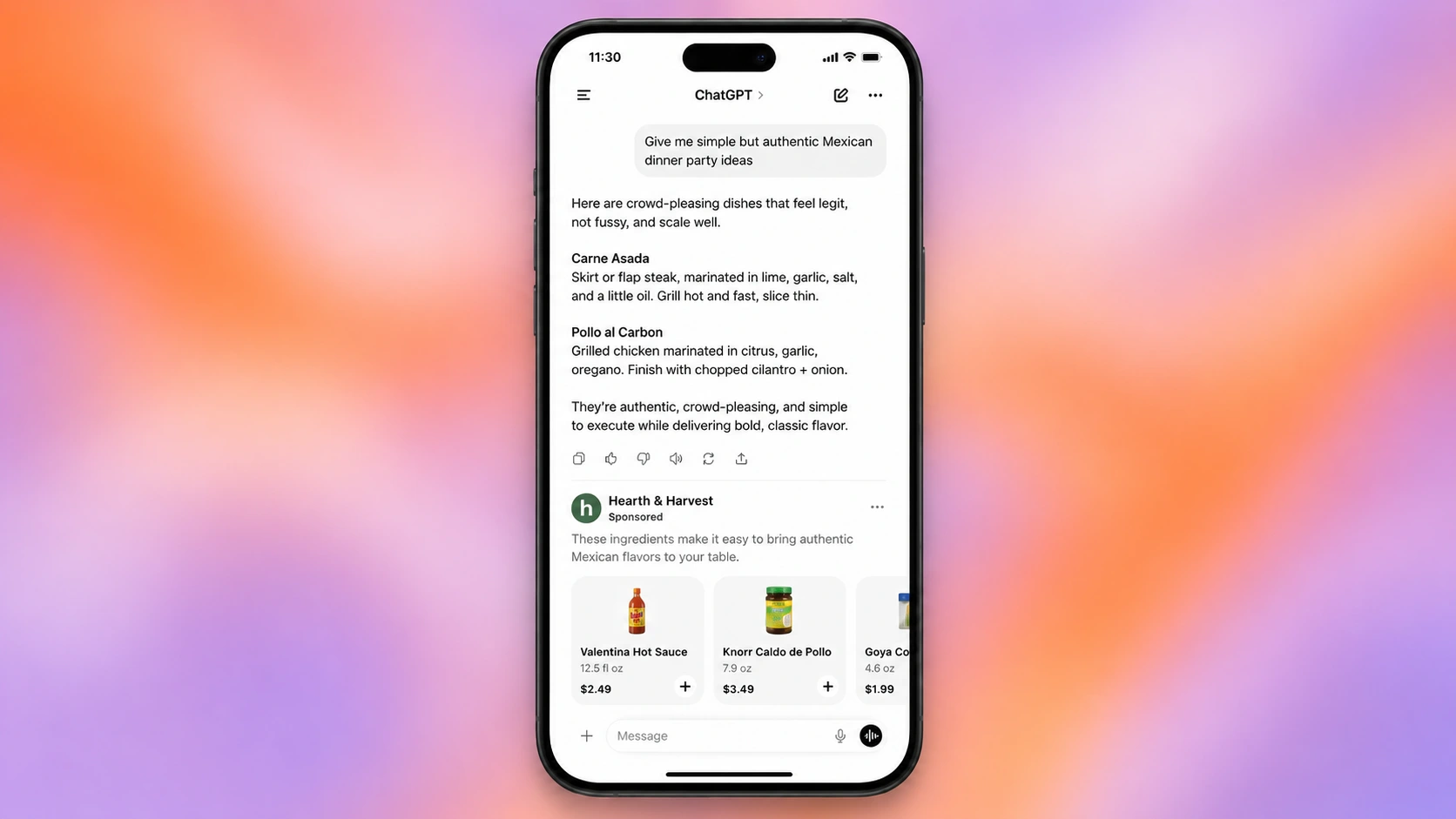
• Ads appear as clearly labelled “Sponsored” placements at the bottom of a response, only for Free and ChatGPT Go users — paid tiers stay ad-free.
• Targeting is contextual: ads are matched to the topic of the conversation, not sold off your personal data.
• Pricing runs on a CPC and CPM model. Early beta inventory was premium (~$60 CPM), but the removed minimum makes it accessible to smaller advertisers.
• SaaS, professional services, education, finance and e-commerce are the strongest early fits.
Table of Contents
Can You Run Ads on ChatGPT Right Now?
Yes. As of 2026, businesses can run ads on ChatGPT in the United States through OpenAI’s official advertising platform. OpenAI began the public test on 9 February 2026 for logged-in US users, and has since expanded both the audience and the tools available to advertisers, with international pilots underway in markets including the UK, Mexico, Brazil, Japan and South Korea.
The important shift for most businesses came a few months after launch. The early beta required commitments reported to be around $200,000, which locked out everyone but enterprise brands. That floor has since been removed, and a self-serve dashboard now lets you set your own budget. You can read OpenAI’s own rollout notes on its testing ads in ChatGPT page. In practice, running ads on ChatGPT is no longer an enterprise-only experiment.
What Are ChatGPT Ads?
ChatGPT ads are sponsored placements shown inside the chat experience. Rather than interrupting an answer, they appear in a clearly labelled, visually separated box beneath ChatGPT’s response. OpenAI has been firm on one principle it calls “answer independence”: advertising never changes the actual answer the model gives you. The ad sits alongside the reply, not inside it.
Who Sees The Ads
Ads are shown to users on the Free tier and the low-cost ChatGPT Go plan (around $8/month). Subscribers on Plus, Pro, Business, Enterprise and Education plans don’t see ads at all. Accounts identified as belonging to under-18s are also excluded. So your audience skews toward everyday, high-volume users — and it’s large, given ChatGPT handles billions of prompts a day.
How targeting works
This is where ChatGPT ads differ most from traditional platforms. Instead of building audiences from harvested personal data, OpenAI matches ads contextually — to the topic of the conversation, your recent chats, and how you’ve interacted with ads before. Someone asking about meal planning might see a grocery-delivery ad; someone comparing project tools might see a relevant SaaS product. The match happens inside OpenAI’s systems, and advertisers receive aggregated performance data rather than individual user information.
| Why this matters: people open ChatGPT when they’re actively exploring, comparing, or deciding. That’s higher intent than passive social scrolling — and it’s the single biggest reason to learn how to run ads on ChatGPT early. |
The OpenAI Ads Manager
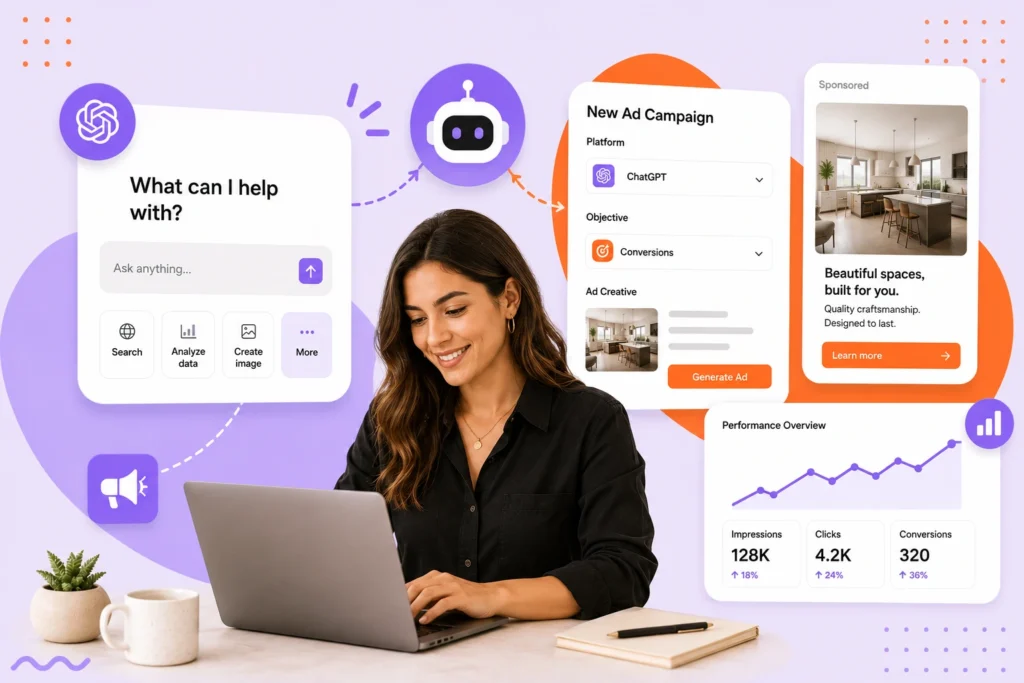
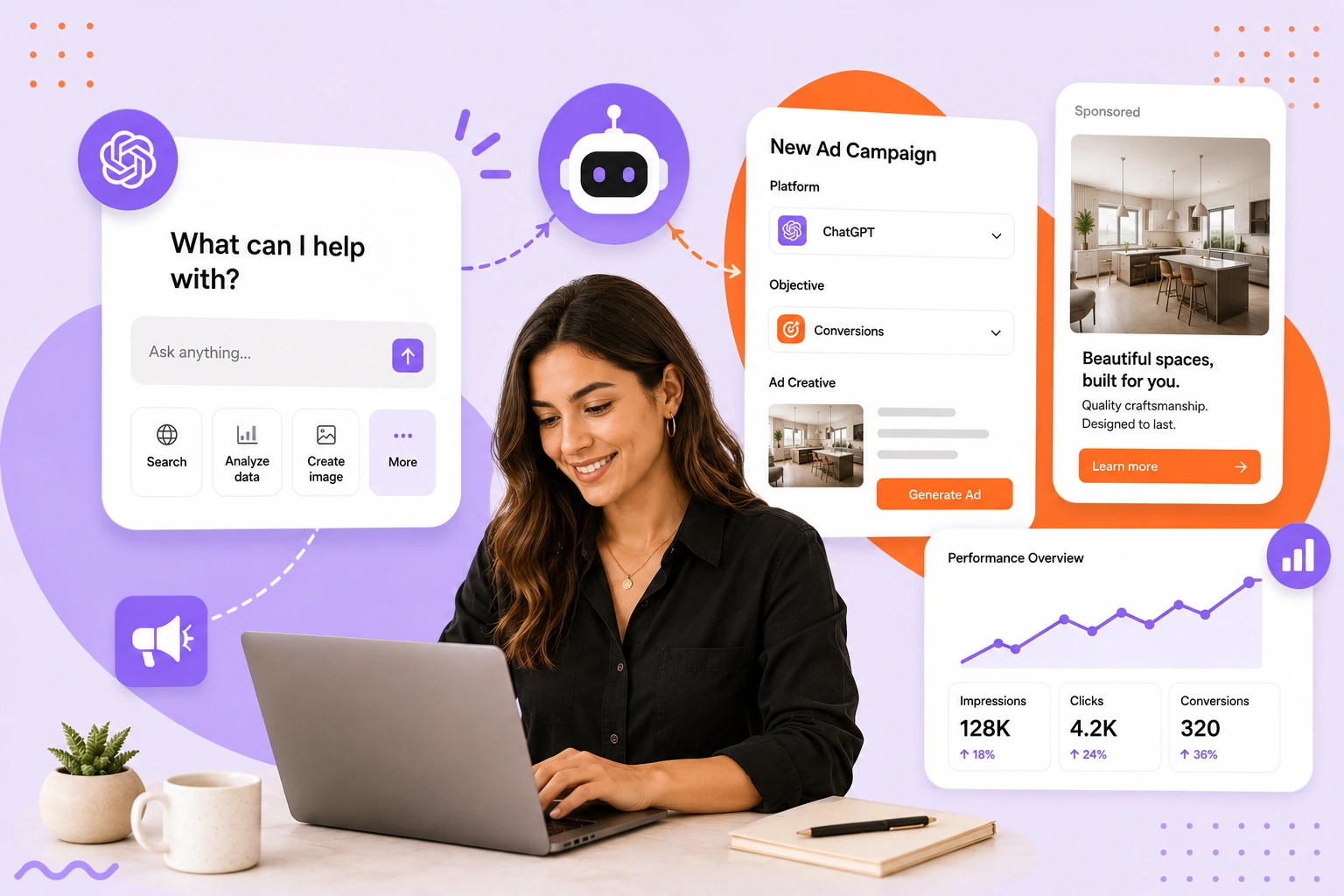
Campaigns are built and managed through the OpenAI Ads Manager, the self-serve platform OpenAI opened to advertisers in 2026. It supports both CPC (cost-per-click) and CPM (cost-per-thousand-impressions) bidding, and — crucially — no longer enforces a minimum spend. You create an advertiser account, set a budget, define your targeting parameters, submit creative, and OpenAI’s review system checks it before it goes live.
Creative standards are stricter than most networks. Because the ad sits next to an AI-generated answer, anything aggressive, misleading or visually jarring tends to get rejected. The system also watches whether users keep engaging with ChatGPT after seeing an ad, and treats people abandoning the conversation as a negative signal. The takeaway: your ad has to read like a genuinely useful suggestion, not a hard sell.
How To Run Ads on ChatGPT: Step by Step
Here’s the practical workflow for getting your first ChatGPT campaign live.
- Create an advertiser account. Register through OpenAI’s advertiser portal at openai.com/advertisers and confirm your business is eligible for the markets you want to target.
- Define your objective and budget. Decide what a result is worth to you (a click, a lead, a sale), then set a daily or campaign budget. With no minimum spend, you can start small and scale what works.
- Choose CPC or CPM bidding. Use CPC when you’re optimising for traffic and want to pay for engagement; use CPM for awareness plays where impressions matter more than clicks.
- Set your contextual targeting. Map your offer to the conversation topics your buyers actually have. Think in natural language — the way a customer would describe their problem to ChatGPT — not in rigid keyword lists.
- Write conversational creative. Lead with the user’s problem and a clear, specific benefit. Skip the slogans. The best-performing ChatGPT ads feel like a helpful answer, not an interruption.
- Submit for review and launch. OpenAI reviews creative against its quality guidelines before it runs. Once approved, your ad enters rotation and starts matching to relevant conversations.
- Measure and refine. Watch your performance data, cut what underperforms, and reinvest in the conversation topics and creative angles that convert. Treat the first 30 days as a learning budget.
How Much Do ChatGPT Ads Cost?
There’s no fixed price — you bid, and cost depends on competition for the conversations you’re targeting. That said, ChatGPT positioned itself as premium inventory from the start. Early beta reporting put CPMs around $60, roughly three times typical Meta rates and well above standard display advertising. The trade-off is intent: you’re reaching people mid-decision, not mid-scroll.
For most small businesses, CPC bidding is the more comfortable on-ramp, because you only pay when someone actually engages. The removal of the spend minimum means you can validate ChatGPT ads with a modest test budget before committing real money. A sensible first test is a few hundred to a few thousand dollars spread across two or three tightly themed campaigns. We break the numbers down further in our ChatGPT ads cost guide.
| Detail | What to expect in 2026 |
| Pricing models | CPC (cost-per-click) and CPM (cost-per-impression) |
| Minimum spend | None on the self-serve Ads Manager |
| Early CPM benchmark | Reported around $60 in beta — premium inventory |
| Best for budgets | Test small, scale winners; treat month one as learning spend |
| Where ads show | Free and ChatGPT Go tiers only |
Who Should Advertise on ChatGPT?
ChatGPT ads work best for businesses whose customers research before they buy — exactly the moment a conversational assistant gets involved. OpenAI’s early rollout leaned into a handful of verticals where this fits naturally:
- Software and SaaS — users comparing tools and asking “what’s the best X for Y”.
- Professional services — agencies, consultants, legal and financial advisors.
- Education and training — courses, certifications and learning platforms.
- Financial services — high-consideration products where guidance matters.
- E-commerce — categories where shoppers research before purchasing.
If your sales cycle involves comparison, explanation, or a considered decision, ChatGPT is a strong fit. If you rely on impulse buys from passive feeds, your budget may still be better spent on social platforms for now.
ChatGPT Ads vs Google Ads
It’s tempting to treat ChatGPT ads as “the new Google Ads”, but they reward a different mindset. Google captures intent through keywords — short, explicit queries. ChatGPT captures intent through context — full conversations where the user explains their situation in detail before any product is mentioned. That richer context can mean better-qualified clicks, but it also means your creative has to match the conversation, not a keyword.
For most businesses the smart move isn’t either/or. Google Ads still owns bottom-funnel search; ChatGPT ads open a new top-and-mid-funnel channel where buyers are forming opinions. Running both, with messaging tuned to each, is how you cover the full journey. If you already run Google Ads management, you have most of the skills you need — the platform is new, but the discipline of testing, measuring and scaling is the same.
Mistakes To Avoid
- Reusing display creative. Banner-style hard sells get rejected or ignored. Write for a conversation.
- Targeting too broadly. Contextual matching rewards tight, specific topic alignment. Narrow beats wide.
- Judging it in a week. Give the system data. Early performance improves as relevance signals accumulate.
- Ignoring the landing experience. A high-intent click still needs a fast, relevant page to convert.
Frequently Asked Questions
Does ChatGPT have ads now?
Yes. OpenAI began testing ads in ChatGPT in February 2026 for US users, and has been expanding the program since. Ads appear only for Free and ChatGPT Go users.
Will ChatGPT have ads on paid plans?
No. Plus, Pro, Business, Enterprise and Education subscribers remain ad-free. Paying for a higher tier — or opting out within the Free tier — removes ads.
How do I sign up to run ads on ChatGPT?
You register an advertiser account through OpenAI’s advertiser portal, then build campaigns in the self-serve OpenAI Ads Manager using CPC or CPM bidding.
Is there a minimum spend to advertise on ChatGPT?
Not anymore. The original six-figure beta minimum was removed when OpenAI opened the self-serve Ads Manager, so smaller businesses can now run ads on ChatGPT with a modest budget.
Do ChatGPT ads affect the answers?
No. OpenAI’s answer independence principle keeps ads separate from responses — ads are matched to the conversation topic but never change what ChatGPT actually tells you.
Want ChatGPT ads run for you — properly?
We’re a European agency expanding into the US, managing ChatGPT and Google Ads for businesses that want results without the learning curve. Month to month, no lock-in.