

Every few years someone announces the death of SEO, and 2026 has made the eulogies louder than ever. AI Overviews sit on top of the results page, ChatGPT answers questions without sending anyone anywhere, and traffic graphs that used to climb are flattening out. So it’s fair to ask: is SEO dead in 2026? The honest answer is that “dead or alive” is the wrong frame. A specific kind of SEO is dying fast. Another kind is barely affected — and if you run a local or service-based business, that distinction changes everything about what you should do next.
The generic advice flooding the internet right now (“SEO isn’t dead, it’s evolving — now invest in GEO too”) is true but useless. It treats a plumber, a SaaS company, and a recipe blog as if search works the same way for all three. It doesn’t. What’s happening to search depends almost entirely on what you sell and how people look for it.
Key takeaways
- SEO is not dead in 2026, but the era of easy traffic from generic informational content is effectively over.
- AI Overviews hit informational queries hardest and local, transactional, and “near me” queries least — which means the searches that actually generate revenue are the most insulated.
- Whether the “SEO is dead” story applies to you depends on your business model, not on the industry as a whole.
- The real shift isn’t SEO vs. AI. It’s a shift in how you measure success — from sessions and rankings to booked jobs and revenue.
- Reviews, Google Business Profile, and brand mentions now matter more than raw backlink counts for local visibility.
In this article:
Is SEO dead in 2026?
No. SEO is not dead in 2026 — but the version of it that many businesses were quietly relying on is. Google still handles the overwhelming majority of the world’s searches, organic search still drives more website traffic than any other single channel, and businesses that show up when someone is ready to buy still win the sale. What has collapsed is a narrow, once-reliable tactic: publishing broad informational content and harvesting the clicks.
That distinction matters because most “SEO is dead” panic comes from watching one number fall — organic sessions to blog content — and assuming the whole discipline is failing. It isn’t. The traffic that’s disappearing is largely the traffic that was never going to call you anyway.
What actually died: the commodity blog post
The clearest casualty of AI search is the generic, answer-a-simple-question article. “What temperature should I set my thermostat?” “How long does a roof last?” “What’s a good credit score?” These are exactly the queries AI Overviews and chatbots now resolve inline. The user gets their answer on the results page or inside ChatGPT and never clicks through.
Studies over the past year have consistently found that when an AI summary appears, users click organic links far less often. The Pew Research Center’s 2025 analysis of AI in search documented that people were roughly half as likely to click a traditional link when a summary was present. For publishers whose entire model was built on informational traffic, that’s genuinely painful.
But look closely at which content is affected. It’s the content that adds no first-hand value — the stuff that simply restated what was already available elsewhere. If your article was one of forty near-identical “ultimate guides” competing for the same term, AI didn’t kill your traffic. It just finished a job that commoditization had already started. The lesson isn’t “stop doing SEO.” It’s “stop producing content a machine can replace in one sentence.”
Why local and transactional search barely changed
Here’s the part almost no one writing about this is emphasizing: the queries that make you money are the ones AI has touched least.
AI Overviews and chatbots are excellent at synthesizing general knowledge. They are far weaker — and far less frequently triggered — on queries that depend on location, urgency, availability, and real-time trust. Consider the difference:
- “How does a heat pump work?” → AI answers it. No click needed.
- “Emergency AC repair near me open now” → AI is not going to dispatch a technician to your house. The user needs a real, local, available business, and Google knows it.
Search research consistently shows AI Overviews appear far less often on local, navigational, and transactional queries than on informational ones. When someone searches with intent to act — book, buy, hire, visit — the results page still hands them a map pack, business listings, and organic results, because a summary can’t complete the transaction. That’s why local service businesses, e-commerce stores targeting purchase-intent keywords, and any company whose customers search to do something rather than learn something have seen far less disruption than the panic implies.
If your best keywords look like “[service] + [city],” “near me,” “emergency,” “book,” “buy,” “hire,” or “[product] for sale,” you are sitting in the most defended part of search. The people telling you SEO is dead are usually optimizing for a completely different kind of query than you are.
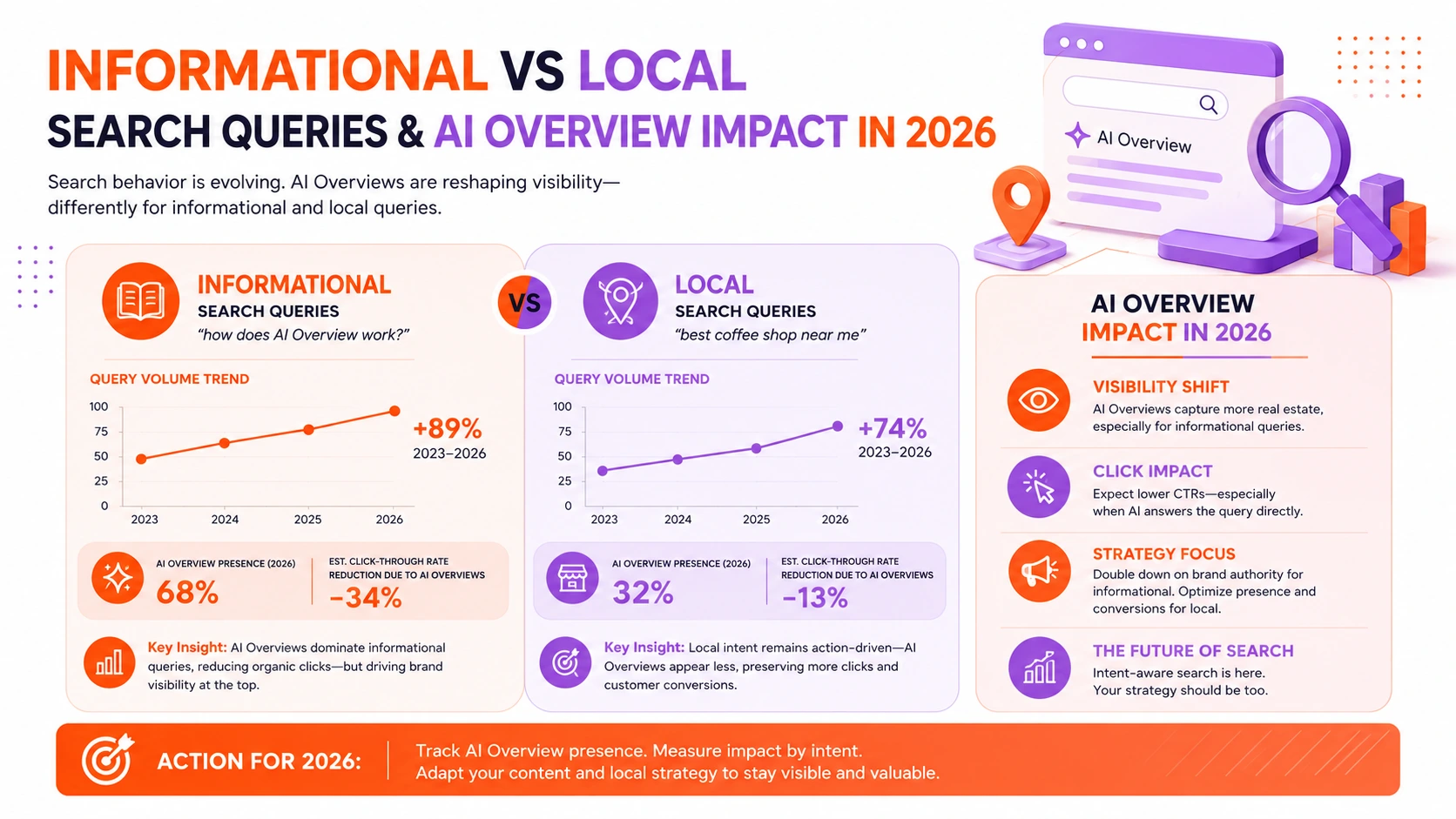
The self-diagnostic: does the “SEO is dead” story apply to your business?
Before you react, figure out which side of the line your business sits on. Ask yourself what most of your valuable searches actually look like.
You’re relatively insulated if:
- Your customers search locally (“plumber in Sofia,” “roofer near me”).
- Your keywords carry buying intent (book, buy, quote, hire, emergency, same-day).
- Trust, reviews, and availability drive the decision.
- The searcher needs a real business to do something, not just an explanation.
You’re exposed if:
- Your traffic came mostly from broad informational or “how-to” content.
- You monetized through ad impressions or affiliate clicks on that content.
- Your articles competed on being comprehensive rather than being uniquely useful.
- A well-written paragraph could fully satisfy the searcher.
Most local and service businesses land firmly in the first group. Most content publishers and thin affiliate sites land in the second. Knowing which you are tells you whether to feel urgency or relief — and it should completely reshape where you spend your next dollar of marketing budget.
What’s genuinely changing (and worth your attention)
Insulated doesn’t mean untouched. Even if your money keywords are safe, the search environment around them is shifting in ways worth getting ahead of.
AI is becoming a referral source, not just a threat
People now research businesses inside ChatGPT, Gemini, and Perplexity — asking for recommendations, comparisons, and shortlists. Being mentioned in those answers is a new form of visibility. The good news: the same things that make you visible to AI (clear, well-structured content, consistent business information, strong third-party reputation) overlap heavily with good SEO. You don’t need a separate “AI strategy” so much as content clean and credible enough for a machine to quote confidently.
The Map Pack and Google Business Profile carry more weight than ever
For local searches, the three-business local pack often gets the majority of clicks before anyone reaches the classic organic results. A fully optimized, actively managed Google Business Profile — accurate categories, services, hours, photos, and a steady flow of recent reviews — is now one of the highest-leverage assets a local business owns. If you’ve been treating it as a set-and-forget listing, that’s the fastest win available to you.
Reviews are a ranking signal and a trust signal at once
Volume, recency, and rating of reviews influence local rankings and directly influence whether an AI or a human recommends you. A steady review-generation habit does double duty. This is one area where a small business can out-compete a much larger, less attentive competitor.
Brand mentions matter more than raw backlink counts
Being named across the web — in directories, local press, supplier pages, and industry sites — increasingly shapes both traditional rankings and AI recommendations, even when those mentions aren’t links. The old game of accumulating as many backlinks as possible has given way to being a genuinely recognized name in your category and location.
Stop measuring traffic. Start measuring booked jobs.
The single most important change in 2026 isn’t a tactic — it’s a metric. If you keep judging SEO by organic sessions, you’ll reach the wrong conclusion, because sessions can fall while your actual business improves.
Here’s how that happens. A prospect asks ChatGPT for a recommendation, sees your name, searches you directly, reads a review, and calls. Your analytics may log that as “direct traffic” or miss the assist entirely. Another prospect gets a general answer from an AI Overview but still clicks through to your transactional page because they’re ready to hire. Traffic to your informational blog drops; leads to your service pages hold steady or rise. The volume looks worse. The business is healthier.
That’s why the businesses pulling ahead have moved their scorecard from traffic to outcomes: qualified leads, cost per acquisition, and booked jobs. Call tracking, form-source tracking, and a simple “how did you hear about us?” field will tell you far more about whether search is working than a sessions graph ever could. When you measure revenue instead of clicks, the “is SEO dead” question usually answers itself — the phone is still ringing.
This is also where combining organic with well-managed paid search pays off: paid captures the ready-to-buy searcher today while organic and local visibility compound underneath, and both get judged on the same currency — cost per booked job.
What to actually do in 2026
If you take one thing from this, let it be a reallocation rather than a retreat.
- Audit your keywords by intent. Separate informational from local/transactional. Accept that informational traffic will keep eroding, and stop investing to defend it unless you can be genuinely, uniquely authoritative.
- Double down where you’re insulated. Build and sharpen your service and location pages — the ones that capture buying intent. This is your defended ground.
- Treat Google Business Profile as a core asset. Optimize it fully and keep it active. For local businesses this often outperforms everything else.
- Build a review habit. Make requesting reviews a standard part of finishing a job. It compounds across rankings, conversions, and AI recommendations.
- Make your best content un-summarizable. First-hand experience, real numbers, original photos, specific local knowledge — the things AI can point to but can’t replace.
- Change your scorecard. Track leads, cost per acquisition, and booked jobs, not just sessions. Measure the thing you actually care about.
For local and home service businesses specifically, this is less a crisis than a clarification. The competitors who panic and chase every AI headline will scatter their effort. The ones who focus on local search that actually books jobs will quietly take share.
Frequently asked questions
Is SEO dead in 2026?
No. SEO is not dead in 2026, but it has split in two. Generic informational content that AI can summarize has lost most of its traffic value, while local, transactional, and buying-intent search remains strong and is far less affected by AI Overviews. For most local and service businesses, SEO is still one of the most cost-effective ways to generate leads.
Is SEO dead or evolving in 2026?
Evolving — sharply. The discipline hasn’t disappeared; it has narrowed toward what AI can’t replace. Success now depends less on ranking a blog post and more on capturing high-intent local searches, owning your Google Business Profile, earning reviews, and being recognized as a real entity across the web and inside AI tools.
Will AI Overviews kill my website traffic?
It depends on what your traffic was built on. If it came from broad informational articles, expect meaningful declines. If it came from local, transactional, or buying-intent searches, the impact is usually small, because AI rarely intercepts a searcher who is ready to hire or buy. Segment your traffic by intent before assuming the worst.
Do I need a separate “GEO” or AI strategy?
For most local businesses, not as a separate project. The fundamentals that make you visible in AI answers — clear structured content, consistent business information, strong reviews, and third-party mentions — are the same fundamentals that make you visible in traditional search. Get those right and you’re optimizing for both at once.
How should I measure SEO success now?
Move away from organic sessions as your headline metric. Track qualified leads, cost per acquisition, and booked jobs instead, using call tracking, form-source tracking, and a simple “how did you hear about us?” question. These reflect real business impact in an era where a valuable search can end without a measurable click.
Are backlinks still important in 2026?
They still matter, but their relative weight has shifted. Being mentioned and recognized across relevant, authoritative sources — even without a link — now influences both rankings and AI recommendations. Focus on becoming a genuinely known name in your category and location rather than chasing link volume for its own sake.
Still seeing your rankings but wondering where the leads went? That gap is exactly what modern search optimization is built to close. See how we approach SEO for service businesses — measured in booked jobs, not vanity metrics.