

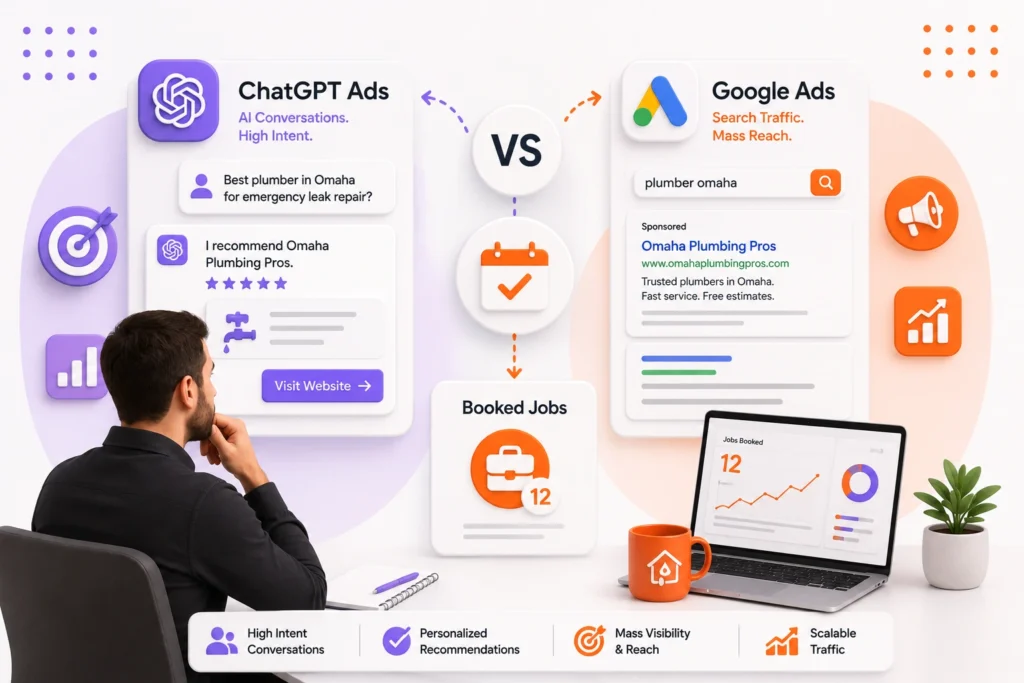
If you run a home service business, the ChatGPT Ads vs Google Ads decision got a lot more interesting in the last ninety days. Until May, ChatGPT ads were effectively a national brand channel — you could not target a metro, you could not track a phone call, and you could not tell the platform what a good outcome looked like. All three of those limits are now gone.
That does not mean you should move your budget. It means the comparison is finally worth running honestly, with real numbers instead of speculation.
Most articles comparing these two platforms measure click-through rate and cost per click. Those are the wrong metrics for a contractor. You do not get paid for clicks. You get paid for booked jobs. When you re-run this comparison on lead quality and cost per booked job, the conclusion changes — not completely, but enough to change what you do this quarter.
Here is the honest version.
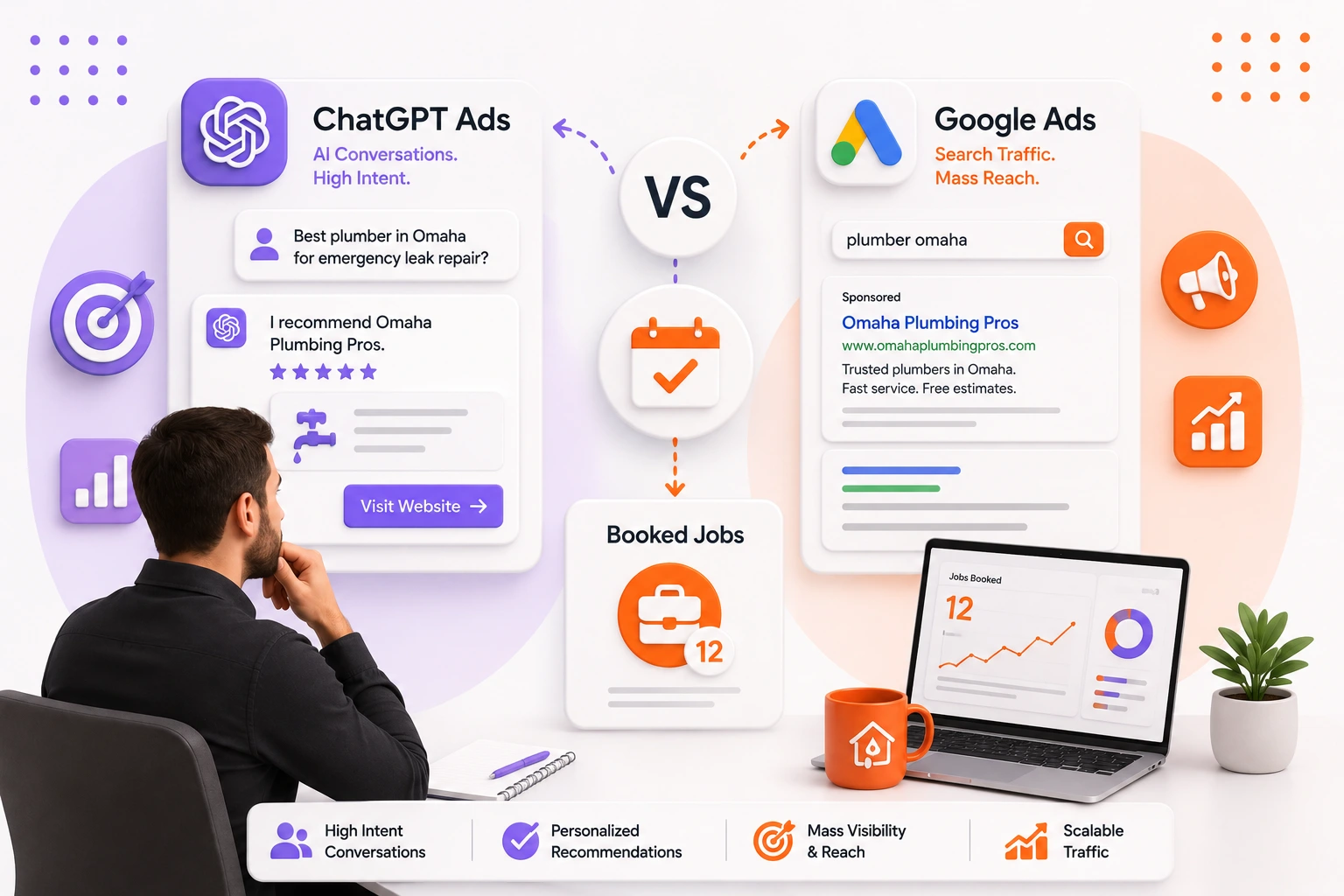
Table of Contents
The short answer, as of August 2026
Google Ads is still where the volume is, and it will remain your primary paid channel for the foreseeable future. Nothing in the ChatGPT Ads vs Google Ads comparison changes that.
ChatGPT ads are a small, high-quality supplement worth a controlled test if you are in a considered-purchase trade — roof replacement, HVAC system installation, remodels, whole-home repipes — where customers research before they call. They are not yet worth your money for emergency and same-day work.
The reason is not ideology. It is that the two platforms catch people at different moments. Google catches the person who has already decided what they need and is choosing who to call. ChatGPT catches the person still working out what they need. For a $12,000 system replacement, that earlier conversation matters. For a burst pipe at 11pm, it does not exist.
What changed in 2026 (and why older comparisons are wrong)
This is a fast-moving topic, and most ChatGPT Ads vs Google Ads comparisons you will find were written before the features that make ChatGPT ads viable for local businesses even existed. The timeline matters:
February 9, 2026 — OpenAI began testing sponsored placements inside ChatGPT for Free and Go tier users in the US.
May 5, 2026 — Self-serve buying opened through the ChatGPT Ads Manager, cost-per-click bidding was added alongside the existing CPM model, and both a measurement pixel and a Conversions API went live. The $50,000 pilot minimum disappeared.
May 22, 2026 — Geographic targeting expanded to state, DMA, and ZIP code level, and daily budget controls arrived. This was the change that turned a national brand surface into something a single-market plumbing or HVAC company could actually buy.
July 24, 2026 — Eight further features landed, the important one being conversion-optimized bidding. Advertisers can now select a conversions objective and let the platform push delivery toward clicks more likely to convert, while still paying per click. Geographic exclusions and average daily budgets with automatic pacing came in the same release.
August 2026 — Call tracking platforms began shipping native OpenAI Ads integrations for closed-loop call attribution, which is the piece service businesses actually needed.
For the full mechanics of the platform itself, see our guide on how to run ads on ChatGPT. If a comparison you are reading says ChatGPT ads are country-level only, or require a six-figure commitment, it is out of date. Check the publish date on anything you read about this platform, including this article.
How each platform decides who sees your ad
Every meaningful ChatGPT Ads vs Google Ads difference starts here, and everything else follows from it.
Google Ads runs on keywords. You tell the platform which searches you want to appear for, layer on location, schedule, device, and audience controls, and bid into an auction weighted by Quality Score. This is the mature, well-documented side of the comparison, and it is what our Google Ads management work is built around. You can target a radius around your shop, exclude ZIP codes you will not drive to, and bid up at 2am when your competitors’ phones go to voicemail. Google’s own documentation on targeting geographic locations covers the full set of controls, and it is deep.
ChatGPT ads run on context hints — natural-language descriptions of the conversations where your service is relevant. There is no keyword targeting. You are not saying “show my ad for water heater replacement Omaha.” You are describing the kind of problem a person would be discussing when your business is the right answer.
That distinction is the whole game. Google Ads rewards you for knowing which keywords signal buying intent. ChatGPT ads reward you for understanding the situations where you are genuinely the right recommendation.
For contractors, this has one practical consequence worth internalizing: on ChatGPT, you cannot buy your way in front of someone who has not raised the topic. There is no equivalent of bidding on a competitor’s brand name and interrupting. The conversation has to already be about the problem you solve.
ChatGPT Ads vs Google Ads: what they cost in 2026
Here is the current ChatGPT Ads vs Google Ads pricing picture, side by side.
| ChatGPT Ads | Google Ads | |
| Bidding models | CPC and CPM, plus conversion-optimized bidding | CPC, CPM, and automated bidding |
| Typical CPC | $3–$5 recommended; bids under $3 struggle to clear delivery | Varies enormously by trade; home services is among the most expensive |
| CPM | $60 default, observed closer to $25 in early pilots | Varies by network |
| Minimum spend | None | None |
| Geographic targeting | State, DMA, ZIP code | Country, region, city, radius, location groups |
| Targeting method | Context hints, no keywords | Keywords, audiences, demographics, remarketing |
| Remarketing | Not available | Extensive |
| Conversion tracking | Pixel and Conversions API | Mature, with call and offline import |
The most important line in that table is the CPC row, and not for the reason you would expect. ChatGPT CPCs sit at $3 to $5 because almost nobody in any given trade has hands-on optimization data yet. In most home service categories, that is well below what the same click costs on Google Search.
That gap is temporary. It exists because the auction is thin, and it will close as more advertisers arrive. That is the actual argument for testing now rather than in a year — not that the channel is better, but that it is currently underpriced.
The click-through gap — and why it is the wrong metric
Now the part most ChatGPT Ads vs Google Ads comparisons lead with, and the one place ChatGPT looks genuinely bad.
Google Ads click-through rates average roughly 4% to 6%, with top-position ads averaging closer to 8%. ChatGPT ads, by Similarweb’s tracking, average about 0.68% overall, with top-quartile advertisers reaching 1.0% and the best performers hitting around 1.57%.
That is a large gap, and if you stop reading there you would conclude the channel is broken.
It is not broken. It is a different placement doing a different job. A ChatGPT ad appears as a recommendation card inside an answer the person is actively reading. Most people finish reading the answer. The ad’s job there is recall and consideration, not an immediate click — which is exactly what the numbers describe.
The mistake is treating click-through rate as a proxy for value. For a contractor, it never was. A 6% click-through rate that produces tire-kickers costs you more in wasted call-handling time than a 1% rate that produces people ready to schedule. Which brings us to the number that actually matters.
Lead quality: where ChatGPT Ads beat Google Ads
This is the finding that should change how you read the ChatGPT Ads vs Google Ads comparison, and it comes from call data rather than click data.
Invoca’s Lead Conversion Benchmarks Report 2026 found that ChatGPT currently generates higher-quality phone leads than any other marketing channel they measure. Specifically, 49% of answered calls originating from ChatGPT were qualified leads — roughly 10 points above the all-channel average, and 6 points above the next-best performing channel. Conversion rates on those calls came in around 40%, which is about average.
Read those two numbers together, because the combination is the insight. ChatGPT sends fewer people, but a much higher share of them are real prospects. They close at a normal rate once they call. They are simply better filtered before they ever pick up the phone.
The explanation is straightforward. Someone who has spent ten minutes working through a problem with an AI assistant arrives better informed and further along in their decision. They already understand roughly what the job involves and roughly what it should cost. They are not calling to ask what a heat pump is.
There is a supporting shift underneath this. Invoca’s B2C Buyer Experience Report 2026 found that 58% of US consumers used generative AI to research a high-stakes purchase, up from 41% the year before. Among Boomers — a group that skews heavily toward home services spending — usage climbed from 11% to 34%, while 85% of them said they still prefer speaking with a person when they are ready to decide.
Research in AI, close on the phone. That is the exact pattern a home service business is built to capture.
Volume: where Google Ads is untouchable
Now the counterweight, because the section above is easy to over-read. Any honest ChatGPT Ads vs Google Ads assessment has to sit with this part too.
Google processes roughly 8.5 billion searches per day. Total call volume attributable to generative AI is still low — that is not a criticism of the channel, it is a description of its current size.
Run the arithmetic for a single metro. A modest ChatGPT ads budget in one DMA, at a 0.68% to 1.5% click-through rate, will produce a handful of clicks per week, not per hour. You are not going to fill a six-truck schedule from this channel in 2026. You will not fill a two-truck schedule from it either.
Google Ads also has capabilities ChatGPT ads simply do not: remarketing, radius targeting around your actual service area, ad scheduling, call extensions, Local Services Ads, and two decades of conversion optimization infrastructure. For emergency and same-day work — the “my water heater is leaking right now” searches — there is no comparison to make. Google wins outright, and it is not close.
So the picture is a small pool of unusually good leads versus a large pool of mixed ones. That framing is what makes the next section possible.
Cost per booked job: the only ChatGPT Ads vs Google Ads comparison that matters
Rankings, impressions, and click-through rates are inputs. The number that determines whether a channel earns its place in your budget is cost per booked job.
Here is how to run that comparison for your own business. The illustrative figures below use published benchmark inputs where they exist; substitute your own wherever you have real data, because your close rate and average ticket are the variables that move the answer most.
Step 1 — Cost per click. Pull your actual average CPC from Google Ads. Use $3 to $5 as the current ChatGPT planning figure.
Step 2 — Clicks to calls. Track this per channel. Do not assume they match. Fewer ChatGPT clicks convert to calls in absolute terms, but the visitors arriving are further along.
Step 3 — Calls to qualified leads. This is where the channels separate. Benchmark data puts ChatGPT-sourced calls at 49% qualified against an all-channel average near 39%. Your own numbers will differ by trade.
Step 4 — Qualified leads to booked jobs. Your close rate. This is a function of your sales process, not the ad platform.
Step 5 — Divide. Total channel spend divided by booked jobs from that channel.
Run it monthly, per channel, and the ChatGPT Ads vs Google Ads decision makes itself. A channel producing five booked jobs at $180 each beats one producing forty at $400 each if your capacity is the constraint — and for most contractors in 2026, capacity is the constraint.
One warning that matters more than anything else here: none of this works if you are not tracking calls by source. A contractor running both platforms without call tracking is guessing, and will almost certainly under-credit the AI channel, because those buyers research in one place and call from another. Last-click attribution systematically undercounts assisted conversions, and this channel is almost entirely assisted.
ChatGPT Ads vs Google Ads: who should test which right now
Worth testing now if you are: a considered-purchase trade with an average ticket above roughly $5,000 — full roof replacements, HVAC system installs, kitchen and bath remodels, whole-home repipes, solar. Long research cycles, high ticket, decisions made by comparison. You have call tracking already in place and a landing page that answers questions rather than just shouting a phone number.
Not worth it yet if you are: emergency-driven or same-day work — burst pipes, no-heat calls, lockouts, drain clears. The buyer is not having a leisurely conversation with an AI assistant. They are typing “emergency plumber near me” and calling the first three results. Also skip it if you are spending under about $1,500 a month total on paid ads, because splitting a small budget across two platforms means neither gathers enough data to optimize.
Skip it entirely if you do not have conversion tracking installed. Running conversion-optimized bidding without accurate conversion data means the algorithm optimizes toward the wrong outcome, confidently, with your money.
How to run both without wasting budget
If you are testing, treat ChatGPT Ads vs Google Ads as an allocation question and structure it as a test rather than a migration.
Keep Google Ads fully funded. This is not a budget reallocation. The test money should be incremental, or come from your lowest-performing Google campaign — not from the campaigns booking your jobs.
Cap it at a few hundred dollars a week for thirty days. Target your two or three best-performing ZIP codes and write context hints tightly around your strongest service line. The goal of this spend is learning the platform mechanics and market response, not hitting a return target in month one.
Instrument it properly before you spend a dollar. Call tracking with source attribution, conversion events firing for phone clicks and form submissions, UTM parameters on every destination URL. Feed offline outcomes back through the Conversions API so conversion bidding has real results to optimize against, not just form fills.
Write for the format. Copy-pasting your Google ad text into ChatGPT campaigns consistently underperforms. Headlines run short — around 30 characters. Write like a helpful recommendation inside a conversation, not a billboard. “Free 30-minute system assessment” reads better in that context than “Best HVAC Company — Call Now!”
Judge it on the right metric. Thirty days in, compare cost per qualified lead and cost per booked job, not CTR or CPC. If the channel is going to prove itself for your business, that is where it will show up.
The bigger AI opportunity most contractors are missing
One last point, and for most home service businesses it is worth more than the entire ChatGPT Ads vs Google Ads ad test.
Buying ChatGPT ads puts you in a sponsored card at the bottom of an answer. Being the business the AI actually recommends inside that answer is a different thing entirely — and it is not something you can buy.
When someone asks ChatGPT which HVAC company in your city to call, or what a furnace replacement should cost in your market, the assistant assembles that answer from sources it can read and trust. Whoever it cites when a buyer asks about pricing effectively sets the reference price for your market. That is not an ad placement. That is structured data, review depth, and content that answers the question directly enough to be quoted.
You can rank first on Google and still be completely invisible in that answer. This is the problem our AI SEO services exist to solve, and it sits alongside the fundamentals covered in our guide to SEO for contractors and home services. The two are separate systems with separate requirements, and the AI visibility side currently has far less competition than the ad auction does — which is exactly the position the ad auction was in six months ago.
If you only have bandwidth for one AI initiative this quarter, that is the one with the longer half-life. Ads stop when the budget stops. Citations do not.
Frequently asked questions
Are ChatGPT Ads better than Google Ads?
No, and the framing is off. For home service contractors in 2026, Google Ads produces far more volume and remains the primary paid channel. ChatGPT ads produce a smaller number of higher-quality leads. The ChatGPT Ads vs Google Ads question is about allocation between complementary channels, not replacement.
How much do ChatGPT Ads cost?
Bidding runs on CPC or CPM. Current guidance puts recommended CPC bids at $3 to $5, with bids under $3 struggling to clear delivery thresholds. The CPM default is $60, though early pilots observed rates closer to $25. There is no minimum spend requirement — the $50,000 pilot minimum was removed in May 2026.
Can a local contractor target just their service area on ChatGPT?
Yes, as of May 22, 2026. Geographic targeting now supports state, DMA, and ZIP code level, and geographic exclusions were added in July. Before that update the platform was country-level only, which made it unusable for single-market businesses.
Will ChatGPT Ads replace Google Ads?
Not in any timeframe worth planning around, which is why the ChatGPT Ads vs Google Ads decision is a budget-split question rather than a switching one. Google handles roughly 8.5 billion searches a day and owns the emergency and high-intent local queries that drive most contractor revenue. The realistic outcome is that AI-assisted research becomes a meaningful earlier touchpoint, with Google still capturing the moment of decision.
How do I track whether a ChatGPT ad produced a booked job?
Install the OpenAI measurement pixel, then layer call tracking with dynamic number insertion so calls carry their source. Feed booked-job outcomes back through the Conversions API. Without call attribution, a service business will systematically under-credit this channel, since the research and the call happen in different places.
Should I run both at the same time?
Only if your total paid budget is comfortably above roughly $1,500 a month and Google Ads is already optimized. Splitting a small budget across two platforms starves both of the data they need. Get Google performing first, then test ChatGPT ads with incremental budget.