







Most guides to local SEO for contractors hand you a checklist of fifteen things and wish you luck. Claim your profile, fix your citations, build links, add schema, post weekly, chase reviews — all true, all listed as if they matter equally. They don’t. When you’re running crews all day, the question isn’t “what are all the tactics?” It’s “which two or three things will actually put more booked jobs on my calendar this quarter, and what can wait?”
This guide answers that. Instead of another flat list, it gives you the mental model most contractors are missing, ranks the work by how fast it produces real leads, and shows you how to tell whether any of it is working — measured in phone calls and signed jobs, not rankings you can’t deposit at the bank.
Key takeaways
- Local SEO for contractors is really two separate contests: the map pack and the classic organic results. They have different ranking factors, and most contractors accidentally compete in only one.
- The highest-ROI work is not evenly spread. Your Google Business Profile and reviews move leads in weeks; service pages and links pay off over months.
- Emergency trades and high-ticket remodel trades need different emphasis — the same checklist doesn’t serve both.
- If your agency reports rankings and traffic but your phone isn’t ringing more, you’re measuring the wrong thing. Track booked jobs.
- Done right, local SEO for contractors becomes a dependable lead source that costs less per job than ads over time — but it rewards consistency, not one-time setup.
In this guide on local SEO for contractors:
What “local SEO for contractors” actually means — and the two battles you’re fighting
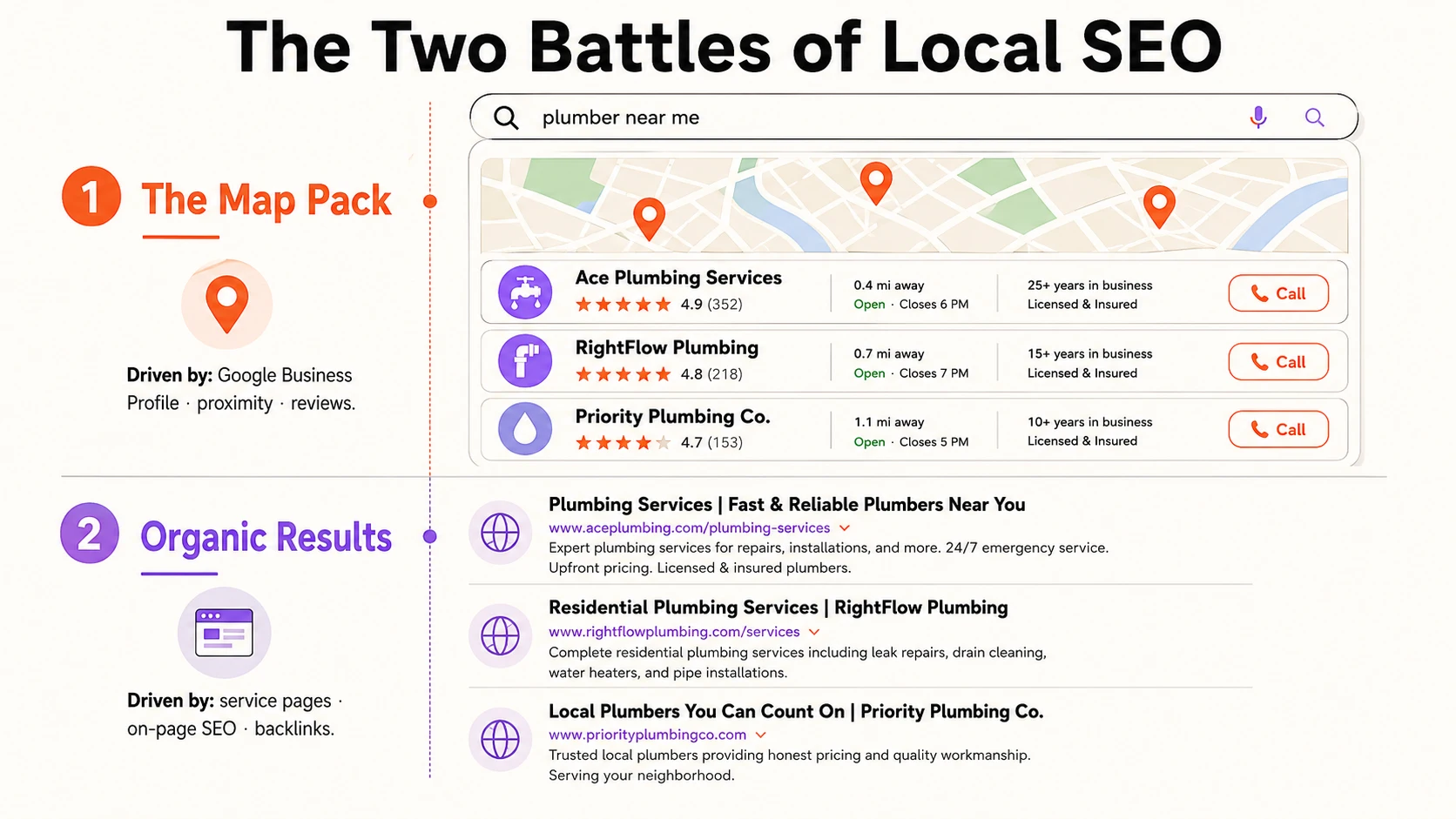
Local SEO for contractors is simply the work that makes your business show up when someone nearby searches for what you do — “emergency plumber near me,” “kitchen remodel [city],” “roof repair [zip].” But here’s what almost no guide makes explicit: a single search usually shows two different sets of results, and you have to win them separately.
The map pack (also called the local 3-pack) is the block of three businesses with the map, star ratings, and call buttons. It’s driven mostly by your Google Business Profile, your proximity to the searcher, your reviews, and how complete and active your profile is. For urgent, “near me,” and mobile searches, this is where most of the clicks go — often before anyone scrolls to a website.
The organic results are the classic blue links below the map. These are driven by your website: your service pages, your content, your on-page SEO, and the links pointing to your site. This is where higher-consideration searchers land when they’re researching a bigger project.
The mistake that quietly costs contractors jobs is pouring effort into one battle while ignoring the other — obsessing over website content while their Google Business Profile sits half-empty, or perfecting their profile while their website has a single “Services” page that can’t rank for anything. You need both, but as you’ll see, not in equal measure and not at the same time.
For the full technical walkthrough of every ranking factor, our complete 2026 guide to SEO for contractors goes deeper. This piece is about priority — what to do first.
Why AI search made local SEO for contractors more valuable, not less
Every contractor we speak to in 2026 asks a version of the same question: if homeowners are asking ChatGPT and reading AI summaries, is any of this still worth doing?
For contractors specifically, the answer is more reassuring than the headlines suggest — and the reason is counterintuitive.
WebFX analysed 237,990 US home services search queries to work out when Google actually shows an AI Overview. The finding that matters to you: adding a local modifier — a city, a state, a neighbourhood — sharply reduces the chance an AI Overview appears at all. Google prioritises the local map pack and branded results over an AI answer for those queries. Visual and service-based searches resist AI takeover for the same reason. Someone typing “AC repair Papillion” is showing Google they want a business, not an explainer, and Google responds by showing businesses.
The practical translation: the searches contractors most want to win are the searches AI has displaced least. Local intent is a shield. Optimised profiles, real reviews, and honest location pages are the defence, and they’re the same work you’d be doing anyway.
Two caveats worth knowing before you relax completely.
First, AI Overviews still show up on the research-stage questions — “how much does a roof replacement cost,” “signs your furnace is failing.” That’s the top of your funnel, and it’s genuinely eroding. The answer isn’t to fight it, it’s to be the source those answers quote.
Second, when AI results do appear locally, proximity still shapes them. A Local Falcon study found businesses closer to the searcher appeared in AI Overview results 72.0% of the time versus 68.5% for those slightly farther away — and that gap held inside a radius of just four miles. The same forces that govern the map pack are governing the AI layer.
If you want to go deeper on that side of things, we’ve written separately on how to improve brand visibility in AI answer engines. For most contractors, though, the sequence is clear: win local search first, because that’s where the money searches still live.
The priority order: what actually books jobs first
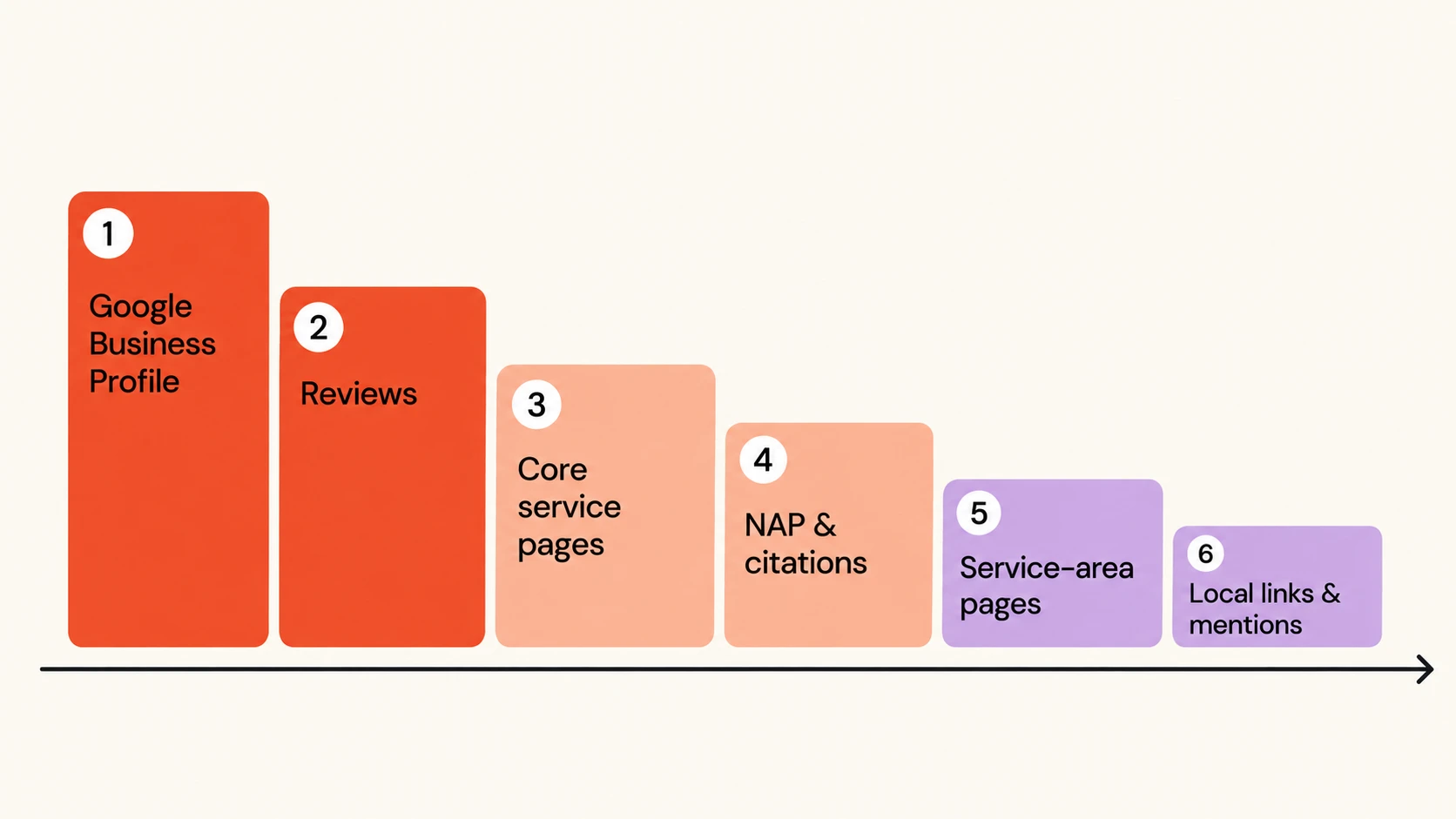
If you did these in order and stopped halfway, you’d still capture most of the available upside. That’s the point. Here’s the sequence ranked by speed-to-leads.
1. Google Business Profile — the fastest lever you have
For most contractors, a fully optimized Google Business Profile is the single highest-return action available, and it can start producing calls within weeks. Choose the most accurate primary category, list every service you actually want to sell, set your real service areas, and write your description in the words customers use, not industry jargon. Then add proof: real jobsite photos, before-and-after shots, your trucks and team — not stock images. Keep it active with short posts about recent jobs or seasonal reminders. Google rewards profiles that look alive, and homeowners trust the ones that show real work.
If you do nothing else this month, do this.
2. Reviews — the trust lever that also ranks you
Reviews do double duty: they’re a direct map-pack ranking signal and the thing that makes a hesitant homeowner choose you over the company above you. Google weighs quantity, recency, rating, and detail — so a steady trickle of fresh reviews beats a pile of old ones. Build one simple habit: at the end of every completed job, send the customer a single direct review link with a short, specific ask. Respond to every review, mentioning the service and the area, because those replies reinforce relevance and signal professionalism. This is the cheapest competitive advantage a small contractor has, and larger, less attentive competitors routinely neglect it.
3. Core service pages — one strong page per money service
Now the website. You don’t need forty pages. You need a dedicated, genuinely useful page for each core service you want to be hired for — built around what buyers actually worry about: scope, process, what affects price, timeline, and what happens after they call. Add an FAQ block to each, because homeowners hesitate at the same predictable points. One thorough “AC Installation” page that answers real questions will out-earn ten thin pages every time.
4. NAP consistency and citations — plumbing, not magic
Your name, address, and phone number need to match everywhere they appear — your site, Google, directories, industry listings. Inconsistencies (“St.” vs “Street,” an old phone number, a slightly different business name) create doubt, and doubt suppresses local rankings. This isn’t glamorous and it won’t spike your leads on its own, but leaving it broken quietly caps everything above it. Fix it once, then keep it clean.
5. Service-area pages — only if you do them properly
City and neighborhood pages can genuinely help if you serve those areas and can add real local substance: specific projects you’ve completed there, local conditions, permit quirks, neighborhood references. What hurts you is the template trap — dozens of near-identical pages with only the city name swapped. Google sees through those, and they can drag down your whole site. Build these slowly and only where you can make them real.
6. Local links and mentions — the long game
Being mentioned and linked across your community — suppliers, trade associations, local sponsorships, real estate partners, chamber listings — builds the “prominence” Google uses to judge your reputation. It matters, but it compounds slowly and rarely produces this week’s lead. It belongs last precisely because everything above it moves faster. Chase relationships and real community presence, not cheap bulk links, which do more harm than good.
Google’s own guidance on improving your local ranking confirms the logic underneath this order: it ranks businesses on relevance, distance, and prominence — which is exactly why your profile, service clarity, and reviews do the heavy lifting.
Match your local SEO to your trade
Here’s a distinction the generic guides skip entirely: not all contractors are chasing the same kind of search, so the emphasis should shift depending on what you do.
Emergency and urgent-service trades — plumbing, HVAC repair, water damage and restoration, electrical, garage doors, locksmiths. Your customers search in a panic, on a phone, and hire fast. The map pack is your battlefield. Proximity, a click-to-call profile, “open now” and same-day signals, and a strong review volume matter more than a big content library. Prioritize items 1 and 2 above relentlessly; make it effortless to call you.
Considered-purchase and high-ticket trades — kitchen and bath remodeling, roofing, additions, custom builds, landscaping. Your customers research for days or weeks, compare portfolios, read reviews carefully, and get multiple quotes. Trust and proof win here. Your website does more work: detailed service pages, project galleries, case studies, and financing or process explainers. Reviews still matter enormously, but so does everything that reassures someone spending $30,000. Items 3 and the proof layer earn their keep.
Most contractors sit somewhere on this spectrum, and knowing where you fall tells you where to spend first. An emergency plumber over-investing in blog content, or a remodeler with a great profile but a bare website, are both leaving money on the table.
Measure local SEO in booked jobs, not rankings
This is where most contractors get burned. An agency sends a monthly report full of green arrows — rankings up, impressions up, traffic up — while the phone rings about the same as always. Rankings are a means, not the goal. The only metrics that pay your crew are leads and booked jobs.
Set up measurement that tracks what matters:
- Call tracking. Use a tracking number on your website and profile so you know how many calls search actually generated, and which pages or profiles drove them.
- Google Business Profile insights. It reports calls, direction requests, website clicks, and the searches that found you — a direct read on whether your map-pack work is landing.
- A simple “how did you hear about us?” on every lead form and phone intake. Low-tech, high-value, and it catches the assists analytics miss.
- Booked jobs and cost per job. Tie it back to revenue. If local SEO for contractors produces leads at a lower cost per booked job than your other channels, it’s working — regardless of what any ranking chart says.
When you measure this way, you stop paying for vanity and start managing a real lead channel. It’s the same standard we hold our own work to, and it’s the fastest way to tell whether contractor SEO is earning its keep or just generating pretty reports.
Honest timelines: when local SEO starts producing leads
Anyone promising overnight results is selling something. Here’s what realistic looks like:
- Weeks: A neglected Google Business Profile that gets fully optimized, plus a review push, can lift map-pack visibility and calls fairly quickly — sometimes within the first month or two.
- A few months: New and improved service pages need time to be crawled, indexed, and earn trust before they rank and convert. Expect a ramp, not a switch.
- Six-plus months: Competitive organic rankings and the payoff from links and citations build over quarters, then compound. The contractors who win are the ones who kept the habit going when it felt slow.
The honest headline: the profile-and-reviews layer is fast, the website-and-authority layer is slow, and you want both running in parallel from the start.
DIY vs. hiring help: what to actually delegate
Plenty of local SEO is genuinely doable yourself, especially the fast-moving basics. A contractor who spends an afternoon fully completing their Google Business Profile, and builds a real review-request habit, has done most of the highest-ROI work without paying anyone.
Where help usually pays for itself is the slower, more technical, and time-consuming layer: building out and optimizing a full set of service and location pages, keeping citations clean at scale, earning local links, and — most importantly — the ongoing consistency that solo operators drop the moment they get busy. The realistic split is: do the profile and reviews yourself, and delegate the website build-out and the month-after-month grind if your time is better spent on the tools or closing jobs.
Frequently asked questions
What is local SEO for contractors?
Local SEO for contractors is the process of getting your business to show up when nearby homeowners and businesses search for the services you offer — in both the Google map pack and the organic results. It combines an optimized Google Business Profile, consistent business information, customer reviews, and service-focused website pages so you appear, and get chosen, at the moment someone needs the work done.
How long does local SEO take to work for contractors?
It depends on the layer. A fully optimized Google Business Profile plus a review push can lift map-pack visibility and calls within a few weeks. Website service pages and organic rankings typically take a few months to build, and competitive local authority compounds over six months or more. The profile-and-reviews work is fast; the website-and-links work is slower but durable.
What matters most for contractor local SEO?
For most contractors, the Google Business Profile and reviews deliver the fastest, largest return, because they drive the map pack where urgent searchers click. After that, strong service pages, consistent citations, carefully built service-area pages, and local links matter — roughly in that order of speed-to-leads.
Do I need a separate page for every city I serve?
Only if you can make each one genuinely useful. Real service-area pages with local projects, conditions, and specifics can help you rank in those areas. Thin pages that just swap the city name tend to hurt more than they help, because Google recognizes and discounts templated, low-value content.
How do I know if my local SEO is actually working?
Ignore ranking screenshots and measure outcomes: tracked phone calls, form submissions, Google Business Profile actions (calls, direction requests, clicks), and — most importantly — booked jobs and the cost per job. If local search is producing jobs at a competitive cost, it’s working, whatever a rankings report says.
Can contractors do local SEO themselves?
Yes, partly. Most contractors can complete and maintain their own Google Business Profile and run a review-request habit — the highest-ROI basics. The slower, more technical work (a full set of optimized service pages, citation cleanup at scale, link building, and ongoing consistency) is where many choose to bring in help so it actually gets done month after month.
Not sure which of these to fix first for your trade? That prioritization — matched to your services, your market, and your margins — is exactly what we do. See how we approach local SEO for contractors, measured in booked jobs rather than vanity metrics.