

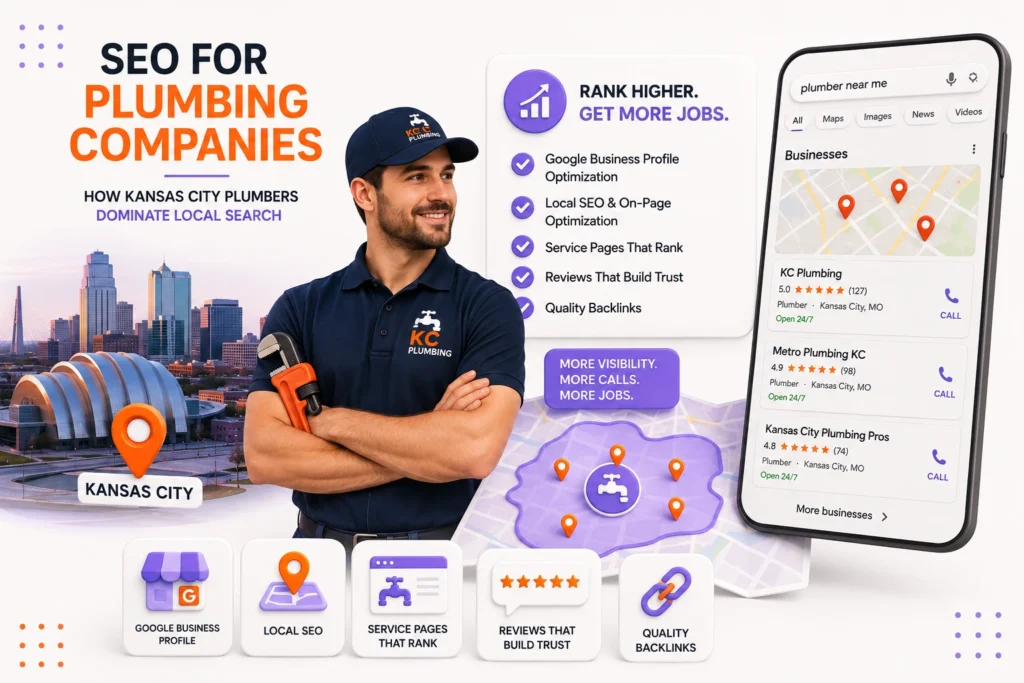
Ask ten plumbing owners in Kansas City how their website is performing and nine will pull out a phone, search “plumber near me,” and point at their own listing. That test is the single most expensive habit in SEO for plumbing companies. The phone is sitting in the shop, and Google is answering the question from the shop’s address. Drive that same phone twelve minutes north to Liberty or twenty minutes southwest to Olathe and the answer usually changes completely.
The plumbing companies that dominate Kansas City search stopped grading themselves on what they see from the dispatch desk. They grade themselves on booked jobs and cost per acquisition. That single change in scorekeeping is what separates the shops running three trucks from the shops running fifteen. Everything that follows about SEO for plumbing companies in this metro depends on it.
This is what the winners actually do, and why the Kansas City metro rewards it more than almost any market in the country.
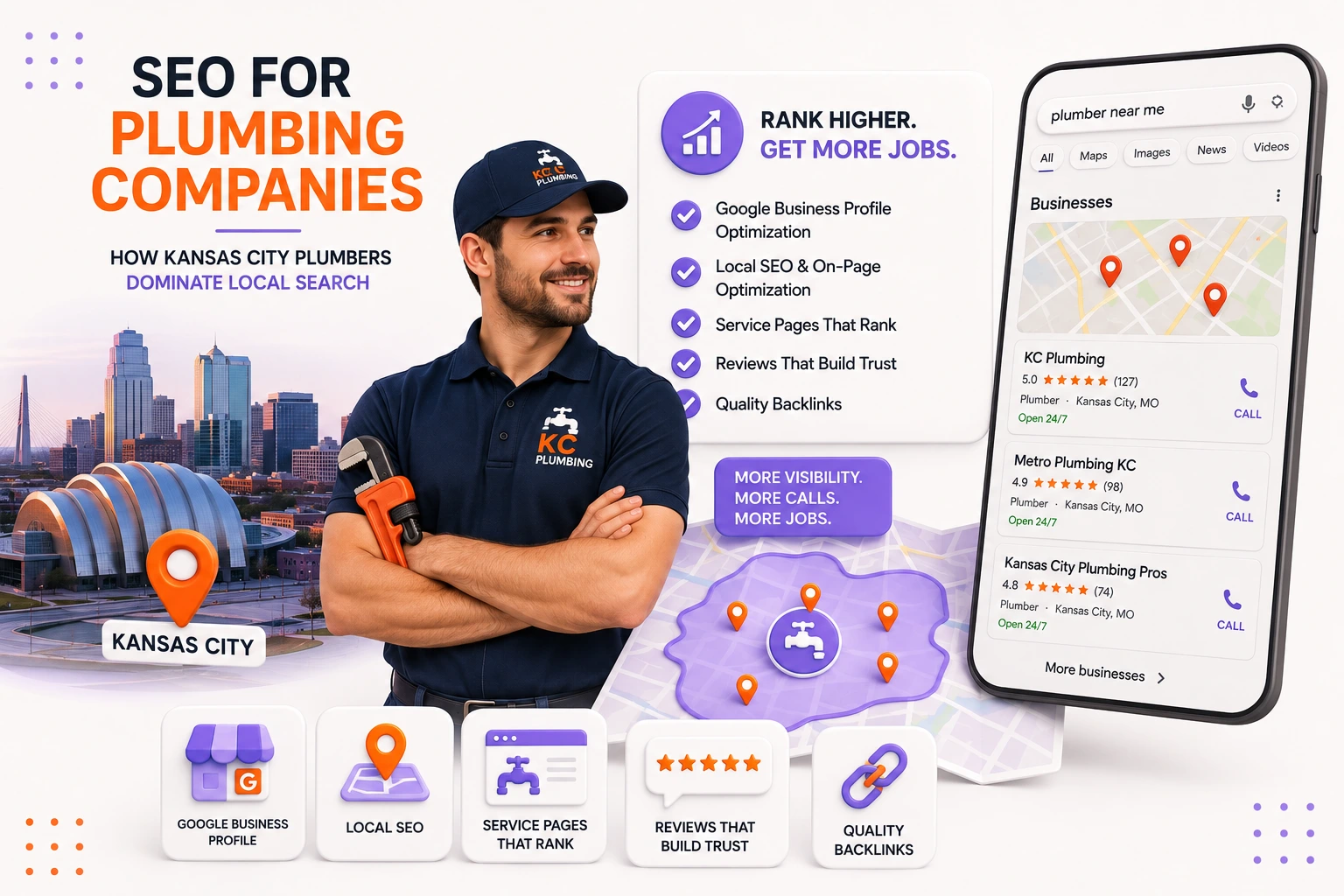
Table of Contents
Why SEO for Plumbing Companies Works Differently in Kansas City
Most national advice treats every metro as one blob. Kansas City is not one blob. It is two states, roughly fourteen counties, and a set of suburbs that behave like independent markets with independent search behaviour.
A homeowner in Overland Park or Leawood is searching inside Johnson County, Kansas. A homeowner in Independence or Lee’s Summit is searching inside Jackson County, Missouri. They are eighteen miles apart and they see almost entirely different map packs. Any approach to SEO for plumbing companies that treats “Kansas City” as one keyword is leaving the majority of the metro uncovered.
Three local factors matter more here than the generic checklists admit:
The 816 and 913 split is a trust signal, not just an area code. Kansas-side homeowners quietly screen for a 913 number. Missouri-side homeowners do the same for 816. If you serve both sides, the number displayed on each city page and each Google Business Profile matters to conversion rate, not just to citations.
The housing stock creates predictable search spikes. Older neighbourhoods on the Missouri side carry cast iron and clay sewer lines that fail in a pattern. The freeze-thaw cycle that runs through January and February drives burst pipe and frozen line searches. Spring storms drive sump pump and basement backup calls. These are not vague seasonal trends — they are specific service pages that need to be indexed and ranking *before* the season, not during it.
Licensing is local, and that is a content advantage. Kansas issues plumbing credentials at the city and county level rather than statewide — in Johnson County, the Contractor Licensing Division within the Department of Planning, Housing and Community Development issues plumbing contractor licenses. Missouri-side jurisdictions run their own process. Most competitor sites never mention which jurisdictions they are licensed and permitted in. Saying it plainly on the page is a genuine trust and relevance signal that costs nothing to add.
Against that backdrop, here are the seven moves that consistently separate the shops winning the metro.
1. They Stop Trusting the Ranking They See From the Shop
Map pack rankings are geographic. Google does not hand out one position per keyword. It calculates a result for the searcher’s specific coordinates, which means your position changes street by street across the metro.
A plumbing company headquartered near the River Market can rank first for “drain cleaning Kansas City” from its own parking lot and be invisible in Shawnee, Blue Springs and Prairie Village at the same time. The owner sees position one, assumes the marketing is working, and cannot understand why the phone is quiet.
Serious SEO for plumbing companies starts with a geo-grid audit: the same keyword checked from dozens of coordinates across the service area, mapped out as a heat grid. That grid is usually the first time an owner sees the truth — a bright green cluster around the shop and a wall of red across two-thirds of the territory they actually want to serve.
Once you have the grid, priorities become obvious. You are no longer guessing which suburbs need a page. The map tells you, and every later decision in SEO for plumbing companies gets cheaper because of it.
2. They Treat the Google Business Profile as the Primary Money Asset
In SEO for plumbing companies, the Google Business Profile outranks the website in commercial value. It is what appears in the map pack, what shows the review count, and what carries the call button — three things a homepage cannot do.
The shops that win treat it as a live asset rather than a one-time setup:
- Primary category set to Plumber, with secondary categories added only where they genuinely apply — Drainage Service, Water Heater Installation, Septic System Service. Category dilution costs rankings.
- Service areas defined by the suburbs they actually service, not a lazy fifty-mile radius that includes towns they would never drive to.
- Photos uploaded from completed jobs, consistently, month after month. A profile with forty recent job photos behaves differently from one with a logo and a truck shot from 2021.
- Services and products populated with the exact language homeowners search — water heater replacement, sewer line repair, hydro jetting, repiping, gas line installation.
- Questions answered before someone else answers them. The Q&A section is public and anyone can respond.
Google publishes the rules for representing a business on its own platform, and they are worth reading in full rather than second-hand. The Google Business Profile guidelines define what is allowed for business names, categories and service areas — and the keyword-stuffed business name that a competitor is currently outranking you with is very often a suspendable violation.
3. They Build One Page Per Service, Not One Long Service List
The most common structural failure in SEO for plumbing companies is a single “Services” page listing twelve offerings in twelve bullet points. That page ranks for none of them.
A homeowner searching “sewer line repair Kansas City” has a specific, expensive, high-intent problem. They want a page about sewer line repair — the diagnostic process, trenchless versus excavation, what it costs, how long the yard stays torn up. A bullet point cannot compete with that.
The structure that works:
- Water heater repair and replacement
- Drain cleaning and hydro jetting
- Sewer line repair and replacement
- Sump pump installation and repair
- Repiping and water line replacement
- Gas line installation and leak detection
- Emergency and after-hours plumbing
Each gets its own URL, its own schema, its own photos of that work, and its own FAQ block. This is also where the economics get interesting: sewer line and repiping searches carry far lower volume than “plumber near me” but convert into four-figure and five-figure tickets. Volume is the wrong metric. Revenue per ranked keyword is the right one.
4. They Build City Pages a Human Would Actually Read
Every plumbing site in the metro has city pages. Almost all of them are the same paragraph with the city name swapped out, and Google treats those exactly the way it says it will.
Google’s own spam policies classify pages built purely to funnel users from many location searches into the same generic content as doorway pages, and they carry real risk. The difference between a doorway page and a page that ranks is whether the content could only have been written about that place.
An Overland Park page should reference the subdivisions and the housing eras common there, the permitting jurisdiction, the response time from your nearest truck, and named jobs you have completed there. A Lee’s Summit page should read differently because Lee’s Summit is different.
Priority order for the metro, based on competition rather than population:
- Tier one: Overland Park, Olathe, Lee’s Summit, Independence
- Tier two: Shawnee, Lenexa, Blue Springs, Liberty, Leawood, Prairie Village
- Tier three: Gardner, Belton, Raytown, Grandview, Gladstone, Riverside
In SEO for plumbing companies, ten strong pages beat forty thin ones every time. If you cannot write four hundred genuinely specific words about a suburb, you are not ready to publish a page for it. Our broader guidance on local SEO for contractors walks through the same principle across other trades.
5. They Turn Every Completed Job Into a Review
Review velocity — the steady rate at which new reviews arrive — moves map pack position more reliably than almost any on-site change you can make. It is the highest-leverage input in SEO for plumbing companies and the one most often left to chance. Most plumbing companies ask for reviews when they remember to. The ones that dominate have removed the remembering.
The mechanism is straightforward. The field service platform already knows when a job closes. ServiceTitan, Housecall Pro and Jobber can all fire a review request automatically at that moment, when the homeowner is most satisfied and the technician’s name is still fresh. A manual process produces a handful of reviews a month. An automated one produces dozens.
Two details separate good review programs from great ones:
Every review gets a reply, including the bad ones, ideally within forty-eight hours. Replies are indexed, they are visible to every future customer reading the profile, and they demonstrate an active business.
Reviews naturally mention the neighbourhood and the service. You cannot script this and should not try — but a technician who says “if you leave a review, mentioning we came out to Waldo for the water heater really helps” gets location and service language into the profile organically.
6. They Win the Emergency Search on Speed
Plumbing has a search pattern almost no other business has: the burst pipe at 2 a.m. There is no consideration phase, no comparison shopping, no second visit. Whoever answers first gets the job.
That turns site speed and call friction into revenue issues rather than technical ones, and it is where SEO for plumbing companies stops being about Google and starts being about answering a phone. The specifics that matter:
- A tap-to-call number fixed in the mobile header on every page, not buried in a footer
- Sub-two-second load on mobile data, because the homeowner standing in a flooded basement will not wait
- An after-hours banner that says explicitly whether you answer at 2 a.m. — most competitors leave this ambiguous and lose the call
- A form with three fields, not eleven
This is also where the honest comparison with paid search belongs. Organic and map pack visibility compound and cost nothing per click, but they take months to build. Google Ads buys the emergency slot tomorrow at a real cost per click. For most Kansas City plumbing companies the correct answer is both — Google Ads carrying the emergency volume while SEO builds underneath it, then ad spend narrowing to the terms organic cannot reach. We break the trade-off down properly in our comparison of SEO versus Google Ads.
7. They Get Cited by AI, Not Just Ranked by Google
This is the newest edge in SEO for plumbing companies, and right now almost nobody in the Kansas City plumbing market is contesting it.
A growing share of homeowners never open a results page. They ask ChatGPT, Gemini or Perplexity: “who’s a reliable plumber in Overland Park?” or “what should a water heater replacement cost in Kansas City?” The assistant answers by citing a handful of sources. You can rank first on Google and be completely absent from that answer.
The pricing question matters most. Whoever gets cited when a buyer asks what a service costs sets the reference price for that entire market. If a competitor’s pricing page is the source, every conversation you have starts anchored to their number rather than yours.
Getting cited depends on things that traditional SEO for plumbing companies largely ignores: complete LocalBusiness and Service schema, consistent entity information across every profile and directory, plainly stated pricing ranges, and content structured as direct answers to direct questions rather than as marketing copy. Our AI SEO services page covers the full approach, and we have deployed it for clients who now appear in AI answers for their core commercial terms.
What SEO for Plumbing Companies Should Actually Cost Per Job
Here is the number that decides whether SEO for plumbing companies is working, and it is not traffic.
Take everything you spend on search in a month. Divide it by the number of jobs booked from search that month. That is your cost per booked job. Compare it to your average ticket and your close rate, and you know within a minute whether the investment works.
Most owners cannot calculate it, because the reporting they receive on SEO for plumbing companies is about sessions and keyword positions. Making it calculable requires three things:
- Call tracking with dynamic number insertion, so calls from organic search, the map pack and paid search are separated rather than lumped together
- Form submissions tagged by source, so the web form on the sewer line page is distinguishable from the general contact form
- A monthly reconciliation against the job board, because a booked call and a completed job are different numbers
That last step is where most agencies stop and most owners get frustrated. A lead is not revenue. Two hundred calls that produce eleven jobs is a different business outcome than sixty calls that produce thirty.
Search commercial intent in this vertical is worth serious money — the term “seo for plumbing companies” alone carries an average cost per click above forty dollars in the United States, which tells you exactly how much competitors are willing to pay to reach the same owner. The homeowner terms behind it are priced accordingly. That is precisely why the cost per booked job, rather than the ranking report, has to be the scorecard.
A Realistic 90-Day Plan
Nobody dominates a metro in a month. This is the sequence for SEO for plumbing companies that produces the fastest honest progress.
Days 1–30: measure and fix. Run the geo-grid audit so you know where you actually rank. Complete and clean the Google Business Profile. Fix name, address and phone consistency across major directories. Repair the technical basics — mobile speed, tap-to-call, schema. Set up call tracking so month two has real data.
Days 31–60: build the core. This is where SEO for plumbing companies stops being maintenance and starts being growth. Publish the service pages for your highest-ticket work first, not your highest-volume. Launch the automated review request from your field service software. Publish the first two or three city pages, starting where the geo-grid showed weakness rather than where population is highest.
Days 61–90: expand and compound. Add city pages tier by tier. Start publishing seasonal content ahead of the season — frozen pipe content in October, not January. Begin building genuine local links through suppliers, trade associations, chambers of commerce and neighbourhood sponsorships. Review the cost per booked job and reallocate.
Most Kansas City plumbing companies see meaningful map pack movement between weeks six and twelve. Competitive service terms in Johnson County take longer. Anyone promising faster on the hard terms is selling you something.
Frequently Asked Questions About SEO for Plumbing Companies
How long does SEO for plumbing companies take to produce booked jobs?
Google Business Profile improvements often move within two to six weeks. Service and city pages generally start producing calls in the two to four month range. Competitive metro-wide terms in a market the size of Kansas City typically take six months or more. The correct expectation is a curve, not a switch.
Is SEO or Google Ads better for a plumbing company?
They solve different problems, and SEO for plumbing companies is the slower of the two. Ads buy the emergency call tomorrow at a fixed cost per click that never goes away. SEO takes months but compounds and does not charge per click. Most successful plumbing companies run both, with ads carrying urgent volume while organic builds beneath it, then reducing ad spend on the terms organic has won.
How many city pages should a Kansas City plumbing company have?
Start with four to six suburbs you genuinely service and can write specifically about, then expand. Forty thin pages built from a template are worse than useless — Google’s spam policies treat them as doorway pages. Depth per page beats page count.
Do reviews really affect rankings that much?
In SEO for plumbing companies, review count, average rating, review velocity and owner response rate are among the strongest map pack signals available to a local business. They also affect click-through and close rate independently of ranking. In this trade, the review program is not a side project.
Can a three-truck shop compete with the national franchises?
In specific suburbs, yes — reliably. Franchises optimise for metro-level terms and rarely build genuine depth for Blue Springs or Prairie Village. That is where a smaller operator wins. Competing head-on for “plumber Kansas City” against a national brand’s budget is a different proposition.
What does SEO for plumbing companies typically cost?
Serious work in a metro this size generally runs from the low four figures per month upward, depending on how many suburbs and services you are contesting. The number to interrogate is not the retainer — it is the projected cost per booked job against your average ticket. Anything priced far below the market usually means templated pages and no local research.
Where This Leaves You
Kansas City is a genuinely winnable market, and SEO for plumbing companies here rewards the operators willing to do the specific work: know where they actually rank, build real pages for real suburbs, automate reviews, answer emergencies faster than the franchise, and get into AI answers before the competition realises that surface exists.
Everything in this guide to SEO for plumbing companies is executable by an owner with time and patience. Most owners do not have either — which is exactly why the shops that commit to it pull away.
If you want to know where you currently stand across the metro, we run a geo-grid audit and a full teardown of your profile, site and competitors, and send it back as a recorded walkthrough rather than a PDF nobody reads. Our full approach to contractor and home services SEO explains how we work, and if you operate further north, our Omaha SEO page covers that market specifically.