







You don’t need more website traffic. You need more roofs to inspect, more estimates on the calendar, and more signed jobs for your crew. That’s the honest starting point for roofing SEO in 2026 — and it’s exactly where most guides on the subject get it wrong. They chase rankings and sessions, then hand you a report full of numbers that never turn into a phone call.
This guide is written for roofing contractors who want the outcome, not the vanity metrics. We’ll walk through what roofing SEO actually is, why the Map Pack behaves differently than you think, and the six things that reliably turn searches into booked jobs — measured the only way that matters: cost per acquired customer.
In this guide on roofing SEO:
What roofing SEO really is (and what it isn’t)
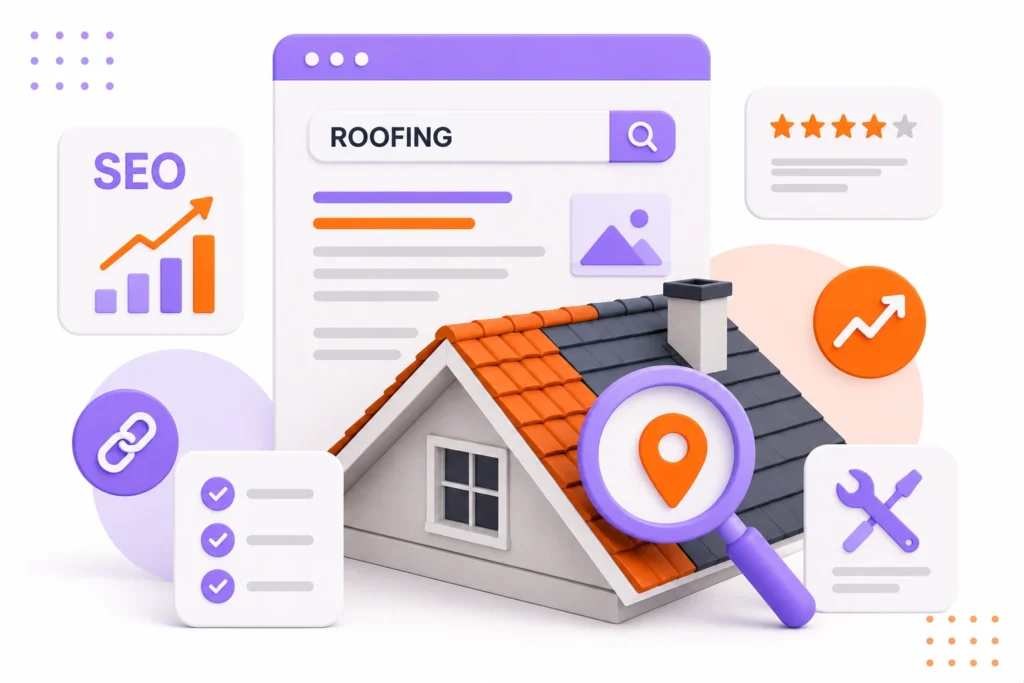
Roofing SEO is the work of making a roofing company the obvious choice when a homeowner in your service area searches for a roof repair, a replacement quote, or storm-damage help. It pulls together your Google Business Profile, your website’s service and location pages, your reviews, and your technical setup so that Google shows your company at the moment someone is ready to hire.
What it isn’t: a monthly report card of keyword positions. Plenty of roofing companies rank in the top three for terms nobody in their town searches, while a competitor with fewer rankings quietly books twice the jobs. Rankings are an input. Booked jobs are the output. If your reporting can’t connect the two, you’re flying blind — and paying for the privilege.
That distinction is the whole game, so it’s worth being blunt about it before we go further.
Why most roofing SEO fails: it measures the wrong thing
Walk into ten roofing SEO agencies and nine will open their report with keyword rankings and organic traffic. Both feel like progress. Neither pays your crew.
Here’s the problem with rankings as a headline metric: they’re notoriously easy to make look good and hard to tie to revenue. Traffic is worse — a spike in visitors from a blog post about “how long does a roof last” brings readers, not buyers. A homeowner researching shingle lifespan is years away from a contract, if they ever hire at all.
The metric that survives scrutiny is cost per acquired job. Take everything you spent on organic search in a month, divide it by the number of booked inspections or signed contracts it produced, and you have a number you can actually run a business on. It tells you whether roofing SEO is cheaper than your other lead sources, and it tells you when to scale. Everything else is decoration.
This is the lens we bring to every roofing company we work with, and it changes which levers you pull. When booked jobs are the target, you stop writing thin blog posts for traffic and start fixing the four or five things that actually move a homeowner from search to signed estimate.
The Map Pack myth every roofer believes
Here’s the mistake we see constantly. A roofer pulls out their phone, searches “roof repair near me,” sees their own business sitting proudly in the top three of the Map Pack, and concludes their local SEO is handled.
It isn’t. And the reason is the single most misunderstood thing about local search.
The Google Map Pack is geographically personalized. What you see depends heavily on where you’re physically standing when you search — and you’re almost always standing at your own shop or job site, which is the exact center of your service radius. So Google shows you your best possible result, every time. A homeowner three towns over, at the edge of your coverage area, sees a completely different set of three businesses — and yours may not be among them.
Google is explicit that physical distance between the searcher and the business is one of the core factors it weighs, alongside relevance and prominence, when it decides which businesses to surface in local results. You can read Google’s own explanation of how it ranks local results in its Business Profile help documentation. Proximity is baked in.
The practical consequence: checking your own ranking from your own location tells you nothing about what a customer across town sees. To understand your real visibility, you need to check rankings from a grid of points across your entire service area — the way a customer would experience it, not the way you do. This is why a roofing company can feel invisible despite “ranking number one,” and it’s the gap that separates roofers who guess from roofers who measure.
The six pillars of roofing SEO that produce booked jobs
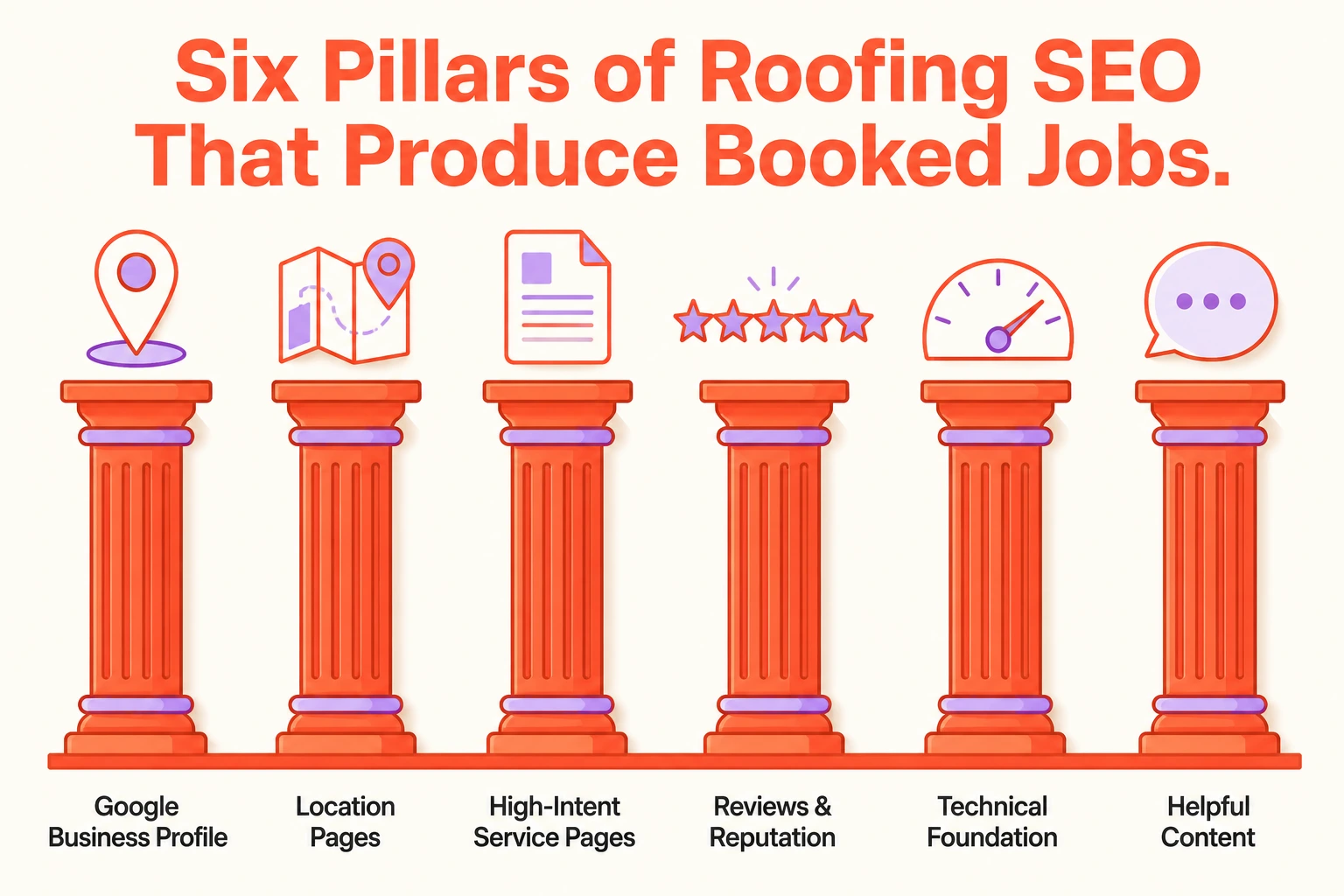
Strip away the noise and durable roofing SEO comes down to six things. In rough order of impact for a local roofing business:
1. Google Business Profile — your real homepage
For local roofing searches, your Google Business Profile does more heavy lifting than your website. It’s what populates the Map Pack, and the Map Pack sits above the regular results where most local clicks happen. Claim it, verify it, and fill in everything: services, service areas, hours, and a steady stream of photos of real jobs — before-and-after storm work converts especially well. A complete, active profile with genuine reviews beats a half-finished one nearly every time.
2. Location pages for every service area
If you serve more than one town, you need a dedicated page for each — not one “Areas We Serve” page with a list of cities. A roofer covering the metro and its suburbs should have a distinct, genuinely useful page for each community, targeting how people actually search: “roof repair in [town],” “[town] roof replacement.” These pages are what let you show up for a homeowner at the edge of your radius, the exact customer your phone-in-hand check never accounts for. This is the same low-competition, high-return approach we map out for every trade on our contractor SEO hub.
3. Service pages for high-intent searches
Homeowners don’t search “roofing.” They search “storm damage roof repair,” “roof replacement cost,” “emergency roof leak,” “insurance roof claim help.” Each of those is a buyer with a specific, urgent need — and each deserves its own page written to answer that need and drive a call. High-intent service pages are where roofing SEO turns a searcher into a booked inspection. Group them under a clear roofing services section so Google understands the depth of what you do.
4. Reviews and reputation
Reviews are both a ranking factor and a conversion factor. A steady flow of recent, genuine reviews signals prominence to Google and trust to homeowners deciding between you and the roofer down the street. Build a simple, repeatable habit of asking every satisfied customer — ideally through whatever field-service software your crew already uses — so it happens without anyone remembering to.
5. A technical foundation that doesn’t leak
Slow, clunky sites bleed jobs. A homeowner with an active roof leak will not wait eight seconds for your page to load — they’ll hit back and call the next roofer. Fast load times, a genuinely mobile-first layout (most roofing searches happen on phones), and a clear tap-to-call button above the fold are the baseline. None of it is glamorous, and all of it moves booked jobs.
6. Content that answers real homeowner questions
Helpful content earns trust and captures searches your service pages can’t — “how much does a new roof cost in [state],” “signs you need a roof replacement,” “does insurance cover storm damage.” The goal isn’t traffic for its own sake; it’s answering the questions a homeowner asks on the way to hiring, so your company is the one that answered them. Written well, this content also demonstrates the expertise Google increasingly rewards.
Roofing SEO vs. Google Ads: which gets you jobs faster?
Honest answer: they do different jobs, and the smartest roofing companies run both.
Google Ads buys you visibility today. The moment your campaign goes live, you can appear at the top for “emergency roof repair” — invaluable during storm season when demand spikes and speed wins. The catch is that the leads stop the instant you stop paying, and roofing keywords are among the most expensive in local services.
Roofing SEO is the opposite: slower to build, but it compounds. Once your profile and pages earn their positions, the leads keep coming without a per-click charge. The cost per job typically drops well below paid channels over time. The trade-off is patience — you’re building an asset, not renting attention.
The right move for most roofers isn’t choosing. It’s running ads for immediate, high-urgency demand while roofing SEO builds underneath, then leaning harder on organic as it matures and reducing your dependence on paid. We manage both as one system so the spend and the rankings inform each other — more on that on our Google Ads management page. Treating SEO and ads as rivals is how roofers overspend on one and neglect the other.
How long does roofing SEO take?
Expect meaningful movement in three to six months, and a compounding return beyond that. Google Business Profile improvements and reviews can shift the Map Pack faster — sometimes within weeks — while competitive service and location pages take longer to earn their positions.
Anyone promising the top of Google in 30 days is selling something. Roofing SEO is a build, not a switch. What you can and should demand from month one is honest measurement: not just rankings, but how many inspections and signed jobs the channel produced, and what each one cost. If your agency can’t show you that, the timeline is the least of your problems.
What roofing SEO costs in 2026
Most roofing companies investing seriously in organic search spend somewhere in the low four figures per month, scaling with the size of the service area and how competitive the market is. Storm-heavy, high-competition metros cost more than quiet single-town markets.
Two things matter more than the headline number. First, whether you’re locked into a long contract — you shouldn’t have to be. A month-to-month arrangement keeps the pressure on the agency to keep producing, which is how it should work. Second, whether the price is tied to outcomes you can see. Paying a flat monthly fee for “SEO” with no line of sight to booked jobs is how roofers end up frustrated. Paying for a system that reports cost per acquired customer is how they grow.
We’re a European agency now working with contractors across US markets, and we structure roofing SEO exactly this way: month-to-month, measured in booked jobs, with direct access to the people doing the work. If you want to see how the pieces fit for your specific market, our contractor SEO hub lays out the full system.
Frequently asked questions about roofing SEO
How much does roofing SEO cost per month?
Most roofing companies invest in the low four figures per month, with the exact figure depending on service-area size and market competition. What matters more than the number is whether it’s tied to a long contract (it shouldn’t be) and whether you can see the booked jobs and cost per acquisition it produces.
How long before roofing SEO produces leads?
Google Business Profile and review improvements can move the Map Pack within weeks. Competitive service and location pages generally take three to six months to earn their positions, then compound from there. Anyone promising the top of Google in a month is not being straight with you.
Is roofing SEO better than Google Ads?
They solve different problems. Ads deliver immediate visibility for urgent, high-intent searches but stop the moment you stop paying. Roofing SEO builds slower but compounds, lowering your cost per job over time. Most successful roofers run both and shift weight toward organic as it matures.
Why does my roofing company rank number one for me but not for customers?
Because the Google Map Pack is personalized by location, and you almost always search from your own shop — the center of your service area — so Google shows you your best result. A homeowner at the edge of your coverage sees different businesses. Real visibility has to be measured across your whole service area, not from your own phone.
Can I do roofing SEO myself?
You can handle the basics — claiming and completing your Google Business Profile, asking for reviews, making sure your site loads fast on mobile. The parts that take experience are competitive location and service pages, technical fixes, and honest measurement. Many roofers start the basics themselves and bring in help once the busy season makes DIY impractical.