







If you run a plumbing company in Omaha, you already know where the jobs come from. A water heater quits in Millard on a Saturday. A basement backs up in Dundee. Someone in Elkhorn wakes up to no hot water and reaches for their phone. They search, they see three businesses under a map, and they call one of them.
Most online advice about SEO for plumbers in Omaha tells businesses the same three things: complete your Google Business Profile, collect more reviews, and wait. That advice isn’t wrong, exactly. It’s just incomplete in a way that costs Omaha plumbers real money — because it skips the single most important thing about how Google Maps actually works for a service business.
Here’s the reality: there is no single “#1 ranking” on Google Maps across Omaha. Understanding why is what separates SEO that actually generates customers for plumbing companies from another monthly report nobody reads.
Not because it’s hard. Because the question is wrong. And once you understand why, the whole strategy changes.
In This Article:
Why “Rank #1 in Omaha” Isn’t a Real Thing
Google Maps doesn’t return one ranking. It returns a different ranking depending on where the person searching is standing.
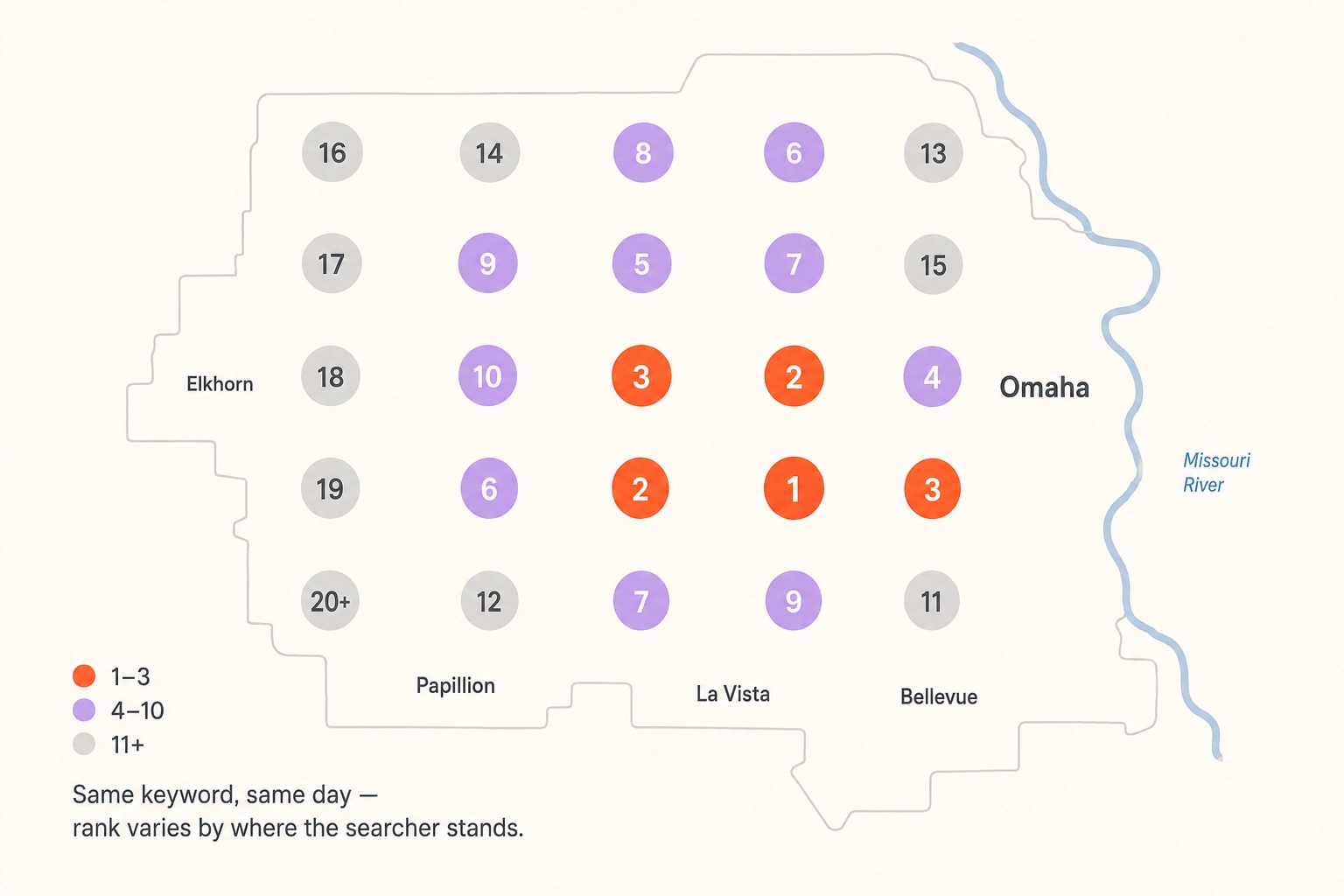
Search “emergency plumber” from a phone in Benson and you get one set of three businesses. Walk the same search into Papillion and you get a different three. Same keyword, same day, same algorithm — different answer, because proximity to the searcher is baked into local results in a way it simply isn’t in normal organic search.
This single fact reshapes the whole approach, and it has a consequence most plumbers never hear about. If you check your own ranking from your shop, you are checking the one location on earth where you are guaranteed to look your best. You’re standing on your own map pin. Of course you’re #1.
Drive four miles and check again. For a lot of Omaha plumbers, that’s the moment the floor drops out.
Picture the metro as a grid. Every square is a slightly different search result. Your business ranks somewhere in every square — first in the ones near your pin, tenth or nowhere in the ones far from it. Your real map pack “ranking” isn’t a number. It’s a shape: a blob of coverage centred on your address, fading as it spreads.
So the honest version of the goal isn’t “rank #1 on Google Maps.” It’s:
Make my blob big enough, and pointed at the right neighbourhoods, that it covers the jobs I actually want.
That reframe is the entire game. Everything below is about growing the blob and aiming it.
How Google Actually Decides the Omaha Map Pack
Google weighs three things for local results — relevance, distance, and prominence.
Relevance is whether your profile and website match what was searched. Categories, services, descriptions, and the content on your site all feed this.
Distance is how far you are from the searcher. You have less control here than you’d like, but more than you think — which is the point of the next section.
Prominence is how established and trusted your business looks. Reviews, citations, links, press, and general web presence.
Of all the settings plumbing companies can adjust today, the primary category has the greatest impact on SEO for plumbers in Omaha. Whitespark’s Local Search Ranking Factors research has consistently identified it as the strongest single lever for both the Local Pack and Maps. It determines which searches you’re even eligible to appear in. Get it wrong and nothing else you do matters much.
Distance and prominence interact, and that interaction is where the opportunity lives. A business with weak prominence only ranks very close to its pin. A business with strong prominence ranks further out — its blob is bigger. That’s why two plumbers at the same address can have completely different coverage across the metro.
You can’t move your building to be closer to every homeowner in Douglas County. You *can* build enough prominence that Google is willing to show you further from your pin.
Step 1 — Pick the Radius That Pays
Before changing a single setting, decide which parts of the metro you actually want to own. This is the step most SEO for plumbers in Omaha campaigns skip, yet it determines everything that follows. Not every area where you would accept a job, but the specific locations where you want to dominate.
This matters because coverage is finite. Effort spread evenly across Omaha, Bellevue, Papillion, La Vista, Ralston, Elkhorn, Millard, and Council Bluffs produces a business that ranks mediocre everywhere. Effort concentrated produces a business that owns three or four zones and gets called constantly.
Work it out on job economics, not geography:
Drive time. A job 25 minutes away at the same ticket price is a worse job. Coverage you win far from base costs you margin on every call.
Job value by area. Omaha’s older housing stock — Dundee, Benson, parts of midtown — has clay tile sewer lines and aging supply plumbing. Those neighbourhoods generate high-ticket sewer and repipe work. Newer builds out in Elkhorn and west Papillion produce more fixture and water heater work: lower ticket, higher volume, easier scheduling. Neither is better. They’re different businesses, and they need different content.
Competition density. Some zones are contested by franchises with big review counts. Some are barely defended. A neighbourhood where nobody has built local content is worth far more of your attention than the one where four companies are already fighting.
Pick three to five zones. Write them down. Everything from here points at that list.
Step 2 — Categories and Service Area
Primary category. For most plumbing companies this is “Plumber.” If emergency work is genuinely your core business, “Emergency Plumbing Service” targets that intent more precisely. Be specific, but be accurate — the category must describe what you actually mostly do.
Secondary categories. Add every service you genuinely provide: Water Heater Repair Service, Drainage Service, Septic System Service, Gasfitter, Bathroom Remodeler if you do it. Each one opens eligibility for a different set of searches. Don’t add categories for work you don’t do; it dilutes relevance and invites bad-fit calls.
Service area, set honestly. As a service-area business you’ll hide your address and define the areas you serve. There is a strong temptation to list the entire metro plus half of western Iowa. Resist it. Your service area doesn’t override proximity — listing Council Bluffs doesn’t make Google show you in Council Bluffs. What an inflated service area *does* do is muddy your relevance signals. Set it to the zones you chose in Step 1, plus a reasonable buffer.
Services and descriptions. Fill out the services section properly, with real descriptions rather than two-word entries. Write your business description for a homeowner in a bad situation, not for a search engine — but do let it naturally include what you do and where.
Step 3 — Reviews Have Geography
Every guide on SEO for plumbers in Omaha tells businesses to get more reviews. Almost none tell you the part that matters for map coverage: where your reviews come from is a signal, not just how many you have.
If every review you have was left by a customer within two miles of your shop, you’ve reinforced exactly the coverage you already had. If your reviews come from Elkhorn, Papillion, Bellevue, and midtown, you’ve given Google evidence that you genuinely serve those places. That evidence is part of what lets your blob grow outward.
Practical version:
Ask on every job, everywhere. Not just the easy ones near base. The jobs at the edge of your target radius are the most valuable reviews you can get.
Ask immediately. A text with a direct review link within a couple of hours of finishing, while the relief is fresh, converts far better than one sent next week.
Let customers mention the specifics. You cannot script reviews, and you shouldn’t try. But asking “if you’ve got a second, it really helps if you mention what we fixed” produces reviews that name the job and often the neighbourhood — naturally, in the customer’s own words. That’s worth considerably more than fifty reviews reading “great service.”
Keep the drip going. Review recency counts. A steady handful every month beats a burst of thirty followed by silence for a year.
Reply to all of them. Including — especially — the bad ones. A calm, specific, non-defensive reply to a complaint does more for a prospect reading it than the complaint does against you.
Step 4 — What SEO for Plumbers in Omaha Has to Do on the Website
Your Google Business Profile doesn’t stand alone. Google reads your website to work out how relevant you are and where you operate, and your site is what has to convert the click into a phone call.
One page per service, properly. A real page for water heater installation, one for drain cleaning, one for sewer line repair, one for emergency plumbing. Each written once, specifically, with genuine detail about what the job involves and what it costs to think about. Copying the same three paragraphs across five pages is the most common self-inflicted wound in this industry.
One page per zone you chose. A real page for Elkhorn, Papillion, Bellevue — whichever zones you picked. And “real” is doing heavy lifting there. Swapping the city name in an otherwise identical template is a well-known pattern and it does not work anymore. A zone page earns its place by containing things that are only true about that zone: the housing stock and its typical age, the plumbing problems that come with it, what you’ve actually done there.
Speed and tap-to-call. Plumbing searches skew heavily to mobile and heavily to urgent. Someone standing in an inch of water will not wait for a slow page or hunt for a phone number. Your number belongs at the top of the screen, tappable.
LocalBusiness schema. Structured data that states your NAP, service area, and hours removes guesswork for Google. It’s a small job and most of your competitors haven’t done it.
Embed a map, name your areas in the footer. Small signals, easy to add.
This is the same architecture we use for contractor and home services SEO across every trade — hub pages for services, spokes for locations, everything linked deliberately so each page reinforces the ones that book work.
Step 5 — Prove You’re Actually Working
Consistency is the most underrated ranking signal in this market. A profile that hasn’t changed in eight months looks abandoned. A profile with fresh, real evidence of work looks like a going concern.
Photos from real jobs. Not stock images of a wrench. The truck outside a house, the completed water heater install, the tech on site. Take them as you work, upload them regularly, and take them across your whole service area rather than only near base.
Posts, occasionally and seasonally. You don’t need to post daily. You need to post when it’s relevant — frozen pipe advice in January, sewer inspection in spring thaw, water softener content in summer.
Answer the Q&A section. Most plumbers ignore it. You can post and answer common questions yourself, which is a legitimate use of the feature and gets useful information in front of someone deciding who to call.
Keep hours accurate. If you genuinely run 24/7 emergency service, say so. If you don’t, don’t claim it — false hours are a well-known suspension trigger, and a suspension costs you every position you’ve built.
Step 6 — Citations and Local Links
Citations are your name, address, and phone listed consistently across the web. The consistency matters more than the volume. “Street” on one listing and “St.” on another is the kind of small mismatch that quietly holds back local rankings. Get the major directories right, get the Nebraska-specific and Omaha-area ones right, and then stop — there’s no prize for listing number four hundred.
Local links are harder and worth more, and they’re where SEO for plumbers in Omaha can genuinely separate themselves. Realistic sources for an Omaha plumbing company: the Greater Omaha Chamber, trade and supplier associations, neighbourhood association sites, local sponsorship of a youth team or community event, and relationships with realtors and property managers who list recommended trades. One genuine local link outperforms a hundred bought directory placements — and bought links can actively set you back.
The Omaha Seasonal Calendar
Demand here is not evenly distributed, and neither should your effort be. Nebraska winters hand Omaha plumbers a seasonal advantage that almost nobody plans around properly. Search interest builds *before* the emergency, so content published in the middle of a spike is already late.
December–February. Frozen and burst pipes. This is peak emergency season in Nebraska. Anything you want ranking in January should be published by October.
March–April. Spring thaw. Ground movement in the metro’s heavy clay soils drives sewer line problems, particularly in the older neighbourhoods. High-ticket work — worth its own content.
May–August. Quieter for emergencies. Better for planned work: water softeners for Omaha’s hard water, outdoor fixtures, bathroom remodel plumbing. Good season to build the content you’ll need in winter.
September–November. Water heater season begins as temperatures drop and failures surface. Also your window to get winter content indexed and ranking before the panic starts.
How to Measure This Properly
Here is where most plumbers get sold a story. An agency sends a monthly report full of keyword positions and traffic graphs, everything is green, and the phone rings the same as last year.
Rankings are not the product. Booked jobs are the product. Any SEO for plumbers in Omaha should be judged on that and nothing else.
Track it like this:
Call tracking, with a separate number on your Google Business Profile. Without it you cannot tell a map pack call from a referral. With it, you know precisely what your profile produces.
Count booked jobs, not calls. Wrong numbers, price shoppers, and people outside your area are all calls. They’re not revenue.
Work out cost per booked job. Total spend divided by jobs actually on the calendar. That single number tells you whether your marketing works. Nothing on a rankings report does.
Check your coverage from more than one place. Since results shift by location, spot-check your position from a few points across your target zones — not just from your shop. A geo-grid tool does this properly; a phone and a bit of driving does it for free.
If a keyword climbs and no jobs follow, that keyword didn’t matter. It’s a genuinely uncomfortable standard and it’s the only one worth using.
Mistakes That Keep Omaha Plumbers Stuck
Checking rankings from the shop. You will always look good standing on your own pin. It tells you nothing.
Chasing “plumber Omaha” and nothing else. The most contested term in the market, and a term searched by people at the very beginning of deciding. “Emergency plumber Millard” or “water heater replacement Papillion” are winnable sooner and convert faster because the person is further along.
Keyword-stuffing the business name. Adding “Best Affordable 24 Hour” to your real business name violates Google’s guidelines. It sometimes works briefly. It risks the whole profile.
Duplicate profiles. Old listings from a previous owner, a former address, or a well-meaning employee split your signals and confuse Google. Find them and get them merged or removed.
Reviews in bursts. Thirty in one month, then nothing. Recency is part of the signal.
Templated location pages. Ten pages identical but for the city name. Google has seen this pattern several million times.
Treating it as a project. Local SEO is not something you finish. Coverage decays when competitors keep working and you stop.
A Realistic Timeline
Here’s what a realistic SEO for plumbers in Omaha timeline looks like.
Weeks 1–6. Profile properly built out, categories fixed, service area set, citations cleaned up, review process running. Map pack movement close to your pin often shows first.
Months 2–4. Service and zone pages published and indexed. Long-tail and neighbourhood searches start ranking. First organic calls typically land here.
Months 4–8. Coverage widens. Reviews accumulate across your target zones. Competitive metro-wide terms come within reach. This is where compounding becomes visible.
Months 8+. You hold your zones. New content ranks faster because the domain has authority behind it. Organic becomes your most reliable and cheapest source of work.
Anyone promising the top of the Omaha map pack in thirty days is either redefining “top” or hasn’t checked from more than one location.
Frequently Asked Questions
How long does SEO for plumbers in Omaha take to produce calls?
Map pack visibility near your own location often improves within about six weeks of properly building out your Google Business Profile and cleaning up citations. Neighborhood and long-tail searches generally start ranking between months two and four. Competitive metro-wide terms take longer — typically four to eight months of consistent work. Anything faster than that usually means the “ranking” is being measured from a single convenient location.
Can an independent plumber outrank Roto-Rooter or Mr. Rooter in Omaha?
Frequently, yes. National franchises carry domain authority, but map pack results reward things that are local and specific: review volume and recency from the actual metro, consistent citations, genuinely local content, and an actively maintained profile. Franchise operators running templated national campaigns tend to be weakest exactly where an attentive local business is strongest.
Do I need a physical address to rank on Google Maps?
You need a real address to verify the profile, but as a service-area business you can hide it from public view and display service areas instead. That’s the normal and correct setup for plumbers. Bear in mind that the hidden address still anchors your proximity, which is why choosing your target zones realistically matters.
Should I do SEO or Google Ads first?
They solve different problems. Ads produce calls now and stop the day you stop paying. SEO takes months to build and then keeps working. Most plumbing companies are best served running both early — ads for cash flow while organic builds underneath — then reducing ad spend as organic coverage takes hold. If you can only do one and you have referral work keeping the lights on, SEO has the better long-run economics.
What does SEO for plumbers in Omaha typically cost?
It varies with how many services and zones you’re targeting and how contested those zones are. Be wary of anyone quoting a price before they’ve looked at your profile, your site, and your competitors — and be equally wary of the cheapest quote you receive. Below a certain price nobody can afford to do the work, and the usual result is a monthly report with nothing behind it.
How do I know if my SEO is actually working?
Put a tracked phone number on your Google Business Profile, count booked jobs rather than calls, and divide your spend by those jobs. If the cost per booked job falls over time, it’s working. If rankings rise and the calendar doesn’t fill, something is wrong regardless of what the report says.
Where to Start
If you take one thing from this: stop asking where you rank, and start asking where you’re *visible* — and whether those places are where the work is.
Check your position from three or four points across the metro, not from your shop. You’ll learn more in twenty minutes than a year of ranking reports will tell you.
We run that check as part of a free audit — the same starting point for every SEO for plumbers in Omaha we take on — your profile, your coverage across the metro, your site, and how you compare to the plumbers currently holding the zones you want. No cost and no obligation. You can see the full scope on our Omaha SEO services page.
The map pack in this city is winnable. Most of your competitors are still checking their rankings from the parking lot.